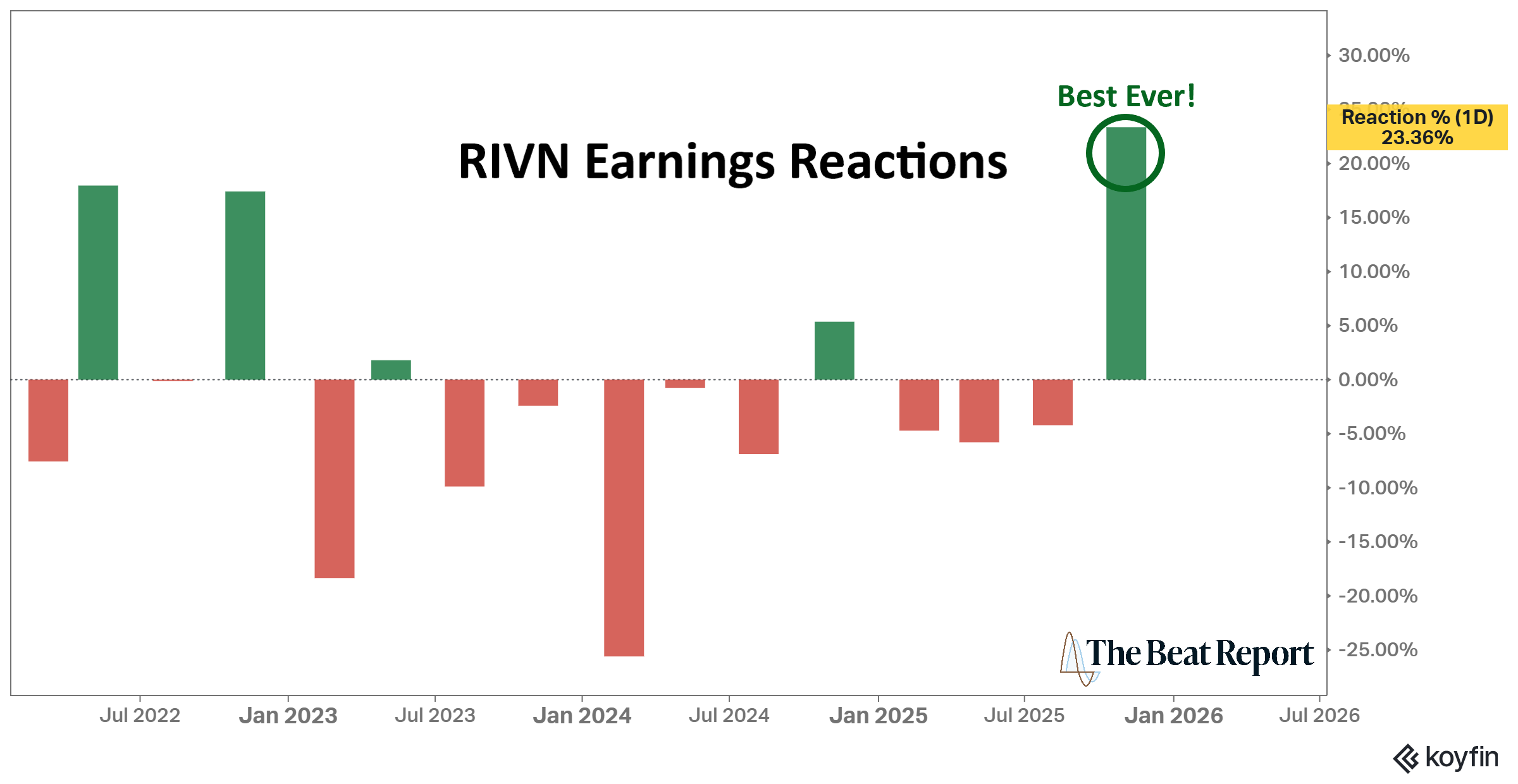
There were no S&P 500 earnings reactions on Tuesday, but we want to tell you about one of the best earnings reactions we saw this season.
Rivian $RIVN has spent the last few years living in the market’s penalty box.
Too many EV hopefuls promised the moon, burned cash, and never built the scale to survive.
Investors learned to shoot first and ask questions later.
So when Rivian finally delivered a quarter that didn’t just “look a little better” but actually changed the company's direction, the response was violent.
And that story is starting to flip because the company is no longer talking like a single-product startup trying to out-hype Tesla. They’re talking like a platform company preparing its second act.
The entire conference call was framed around execution on two parallel tracks: getting R2 to launch, and building the software and autonomy roadmap that turns a good vehicle into a durable ecosystem.
Management reiterated that they’re making progress on R2 development and validation, with manufacturing validation builds scheduled for year-end and a ramp plan starting with limited volumes in the first half of 2026, accelerating in the second half.
That matters because R2 is where Rivian moves from a niche “premium adventure” brand to one that addresses the largest segment of the U.S. auto market: five-seat SUVs and crossovers at a mass-market price point.
The company has explicitly positioned R2 around consumer choice and affordability, noting that the average new-vehicle price is just over $50k.
In other words, this isn’t “more R1.” It’s a deliberate re-architecture for volume, with a product designed to be cross-shopped against the default option in that segment.
The market likes stories, but it pays up for math.
In their latest earnings report, the company put some numbers behind the pivot. They reported approximately $1.6B in revenue and a small consolidated gross profit, while still incurring a sizable adjusted EBITDA loss.
They produced 10,720 vehicles and delivered 13,201 in Q3, in the highest delivery quarter of the year.
The auto segment still posted negative gross profit, but management emphasized improved unit economics and one of its best quarters for automotive cost of goods sold per unit delivered, driven by lower material costs.
That’s not “problem solved,” but it is the kind of incremental progress the market demands before it will re-rate a broken chart.
Then there’s the part investors did not expect to matter as much as it does: software and services. Rivian reported $416M in software and services revenue, with roughly half of that revenue coming from the joint venture with Volkswagen.
That’s the quiet cheat code in this story.
While most EV makers are fighting for survival on vehicle margins alone, this company is building an adjacent revenue stream tied to the industry's convergence toward software-defined vehicles.
The VW partnership also ties into capital. The management team discussed the potential to receive additional capital associated with the JV, with a portion expected in 2026.
Typically, when we see a company that is still burning cash, credible “non-dilutive-ish” funding paths change how investors handicap the runway.
With all of these positive fundamental developments, it's no wonder RIVN just had its best earnings reaction ever.
Since going public in late 2021, the market has treated every Rivian earnings event as another opportunity to punish uncertainty.
This time was different...
Following a big double beat, RIVN had its best earnings reaction ever.
You only see the market react better than ever when positioning and expectations get trapped on the wrong side of an improving reality.
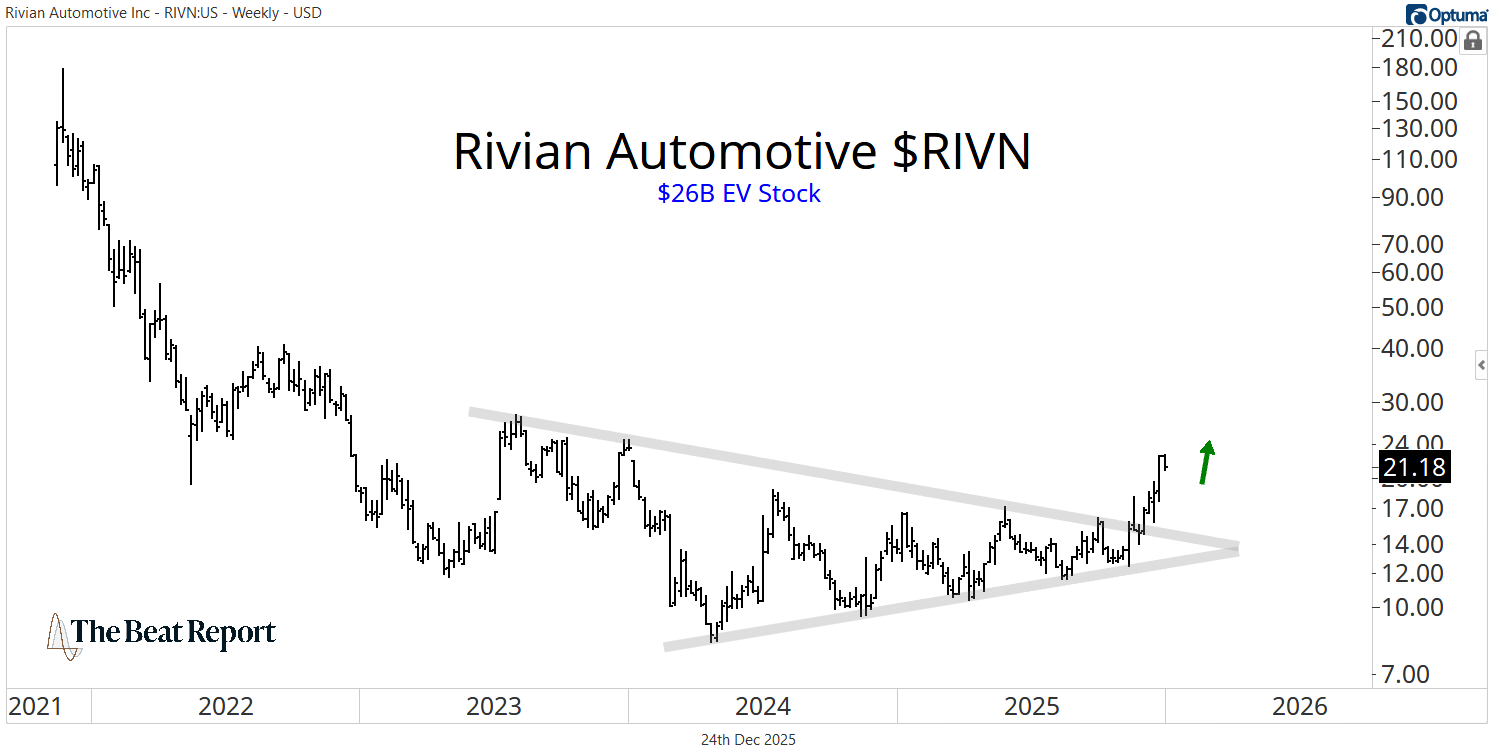
Looking at the technicals, this looks like the beginning of a much bigger move.
After a brutal multi-year downtrend and accumulation phase, RIVN is now in the early stages of a brand-new primary uptrend.
And the breakout came on the heels of the stock's best-ever earnings reaction, which is exactly the type of “regime change” signal we look for in fusion analysis: fundamentals improving at the margin, narrative clarity increasing, and price confirming.
That’s how failed stocks stop being failed stocks.
By blending technicals with fundamentals, we can catch RIVN before the mainstream.
Merry Christmas Eve
-The Beat Team
P.S. Do you want to catch the market’s biggest moves before they occur?
Our new daily note, The Squeeze Watch, delivers the tightest coil patterns straight to your inbox every day, completely free.