Crypto’s Adults Are in the System

Tether is back in the headlines, and as usual, something smells off.
S&P Global downgraded Tether's $USDT stablecoin from 4 to 5 — the worst rating on its stability scale.
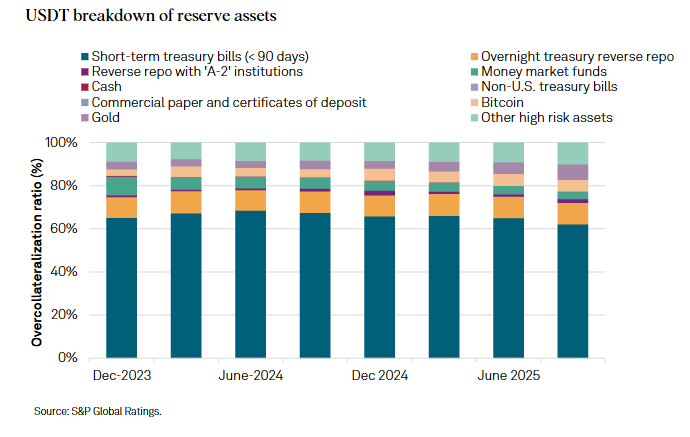
The reasons were straightforward: poor transparency and something relatively new for the company — they’re buying a lot of Bitcoin.
This should concern anyone. A stablecoin has one job: stay pegged to $1. So why is the world’s largest stablecoin backing itself with assets that can swing wildly in a single day?
And it’s not just Bitcoin.
Tether also holds other high-risk assets.
Just take a look at Tether's reserves over the last two years.
The second-largest stablecoin, Circle’s $USDC, is the opposite story.
While Tether is taking riskier bets, Circle’s $USDC is 100% backed by cash and U.S. Treasuries — exactly what you’d expect from a stable, boring dollar proxy.
And unlike Tether, Circle ($CRCL) is a public company that undergoes intense scrutiny and must file regular audit reports. Tether’s attestations don’t come close to what you’d expect from a company claiming profits comparable to Goldman Sachs.
This leads to a broader point.
Crypto began as a rebellion against the traditional financial system, yet the only players consistently acting like adults are those already operating inside it.
Meanwhile, offshore players like Tether end up being the least transparent and the highest-risk.
The irony is hard to miss: the Wall Street–style regulation and discipline crypto tried to escape is the very thing that actually produces safety and trust.
And that’s exactly what the industry needs if it wants to move forward.
From where the sun rises first,
Louis Sykes
Senior Crypto Analyst, All Star Charts