And sometimes they work out faster than you dared to hope.
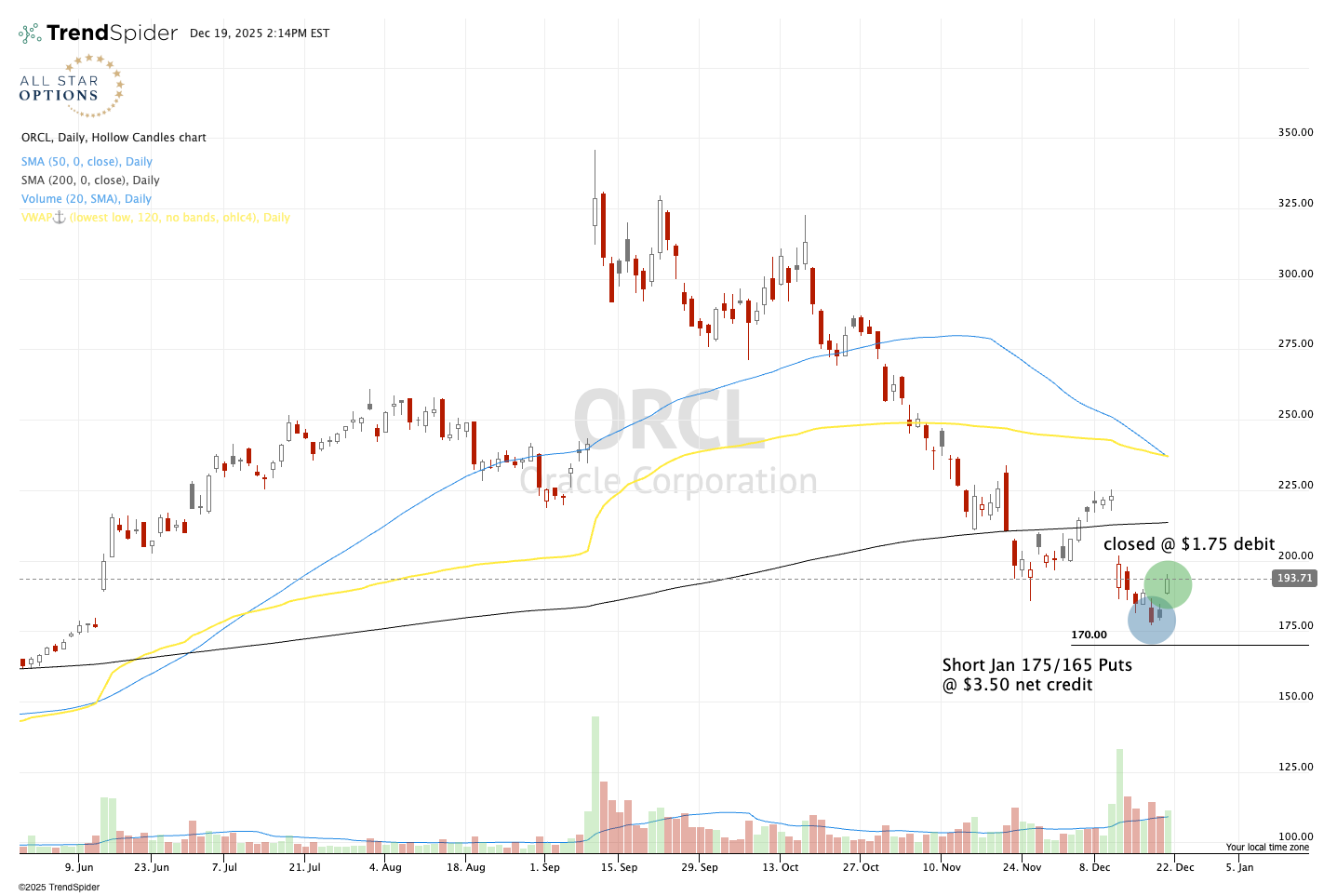
On Wednesday, I entered a bull put spread in Oracle $ORCL, selling the January 175 puts and buying the January 165 puts. I collected a net credit of $3.50.
Here's what I wrote to All Star Options subscribers that day:
"Today's trade either works or doesn't and we'll find out quickly. $ORCL has been at this level before a couple other times this year. Feels to me this is a logical spot to bounce. And while off the high levels heading into the most recent earnings report, implied volatility is still pretty high. This gives me some nice premium to sell in nearby puts that will cushion the blow if I'm dead wrong."
I was right.
But even I'm surprised by how quickly this trade hit its profit target.
We're talking days. Not weeks. Not the typical timeline for my style of swing trading. Just a quick bounce, rapid decay in the short puts, and boom—profit target hit.
It's nice when a plan comes together:
Here's what made this setup work: technical support meeting elevated implied volatility. ORCL had held this level multiple times earlier in the year. The chart suggested a bounce was likely. And the options premiums were fat enough to sell puts at strikes that gave me plenty of cushion.
That's the sweet spot for bull put spreads. Strong technical support plus juicy premiums equals favorable odds.
The quick exit wasn't because I'm a genius or have some secret timing system. It was because the stock did what it was likely to do—bounced off support—and the short premium decayed rapidly as volatility compressed.
When both of those things happen simultaneously, you get these fast wins.
It doesn't happen often with my approach. I'm typically holding positions for weeks, managing them through normal volatility, trailing stops as they work. Most of my trades take time to develop.
But every once in a while, everything aligns and you get rewarded quickly.
What I love about this trade is the risk-reward setup. I collected $3.50 on a $10-wide spread. If ORCL had continued falling and broken through support, my max loss would have been $6.50. But for that defined risk, I positioned for a high-probability bounce at a logical support level.
And when I'm collecting 35% of the spread width in premium? Those odds work in my favor over time.
The key is recognizing when all the pieces are in place. Technical support that's held before. Elevated IV offering better-than-normal premium. A thesis that resolves quickly—either it bounces or it doesn't.
When you see that combination, these short premium setups become incredibly attractive.
Not every trade needs to be a home run. Sometimes a quick single that hits your profit target in a few days is exactly what you want. Low stress. Quick return on capital. Money you can redeploy into the next opportunity.
And honestly? It's nice to pad the stats heading into the final days of the year.
Some years you're grinding it out until the last day. Some years you get a few gifts in December that make the year-end numbers look even better.
I'll take it.
The lesson here isn't about being lucky or perfectly timing the bounce. It's about recognizing favorable setups when they appear and structuring trades that work even if your timing isn't perfect.
If ORCL had chopped around for another week before bouncing, this trade still would have worked—just slower. If it had dropped another few points before finding support, I would have had some cushion from the premium collected.
That's the beauty of selling premium at logical support levels with defined risk. You don't need to be precisely right. You just need to be generally right about direction and let time and volatility work in your favor.
This one happened to work quickly. Most won't. But they don't need to.
Consistency over time beats perfection on any single trade.
--> If you'd like to receive these notes in your email, sign up here.
Sean McLaughlin | Chief Options Strategist, All Star Charts