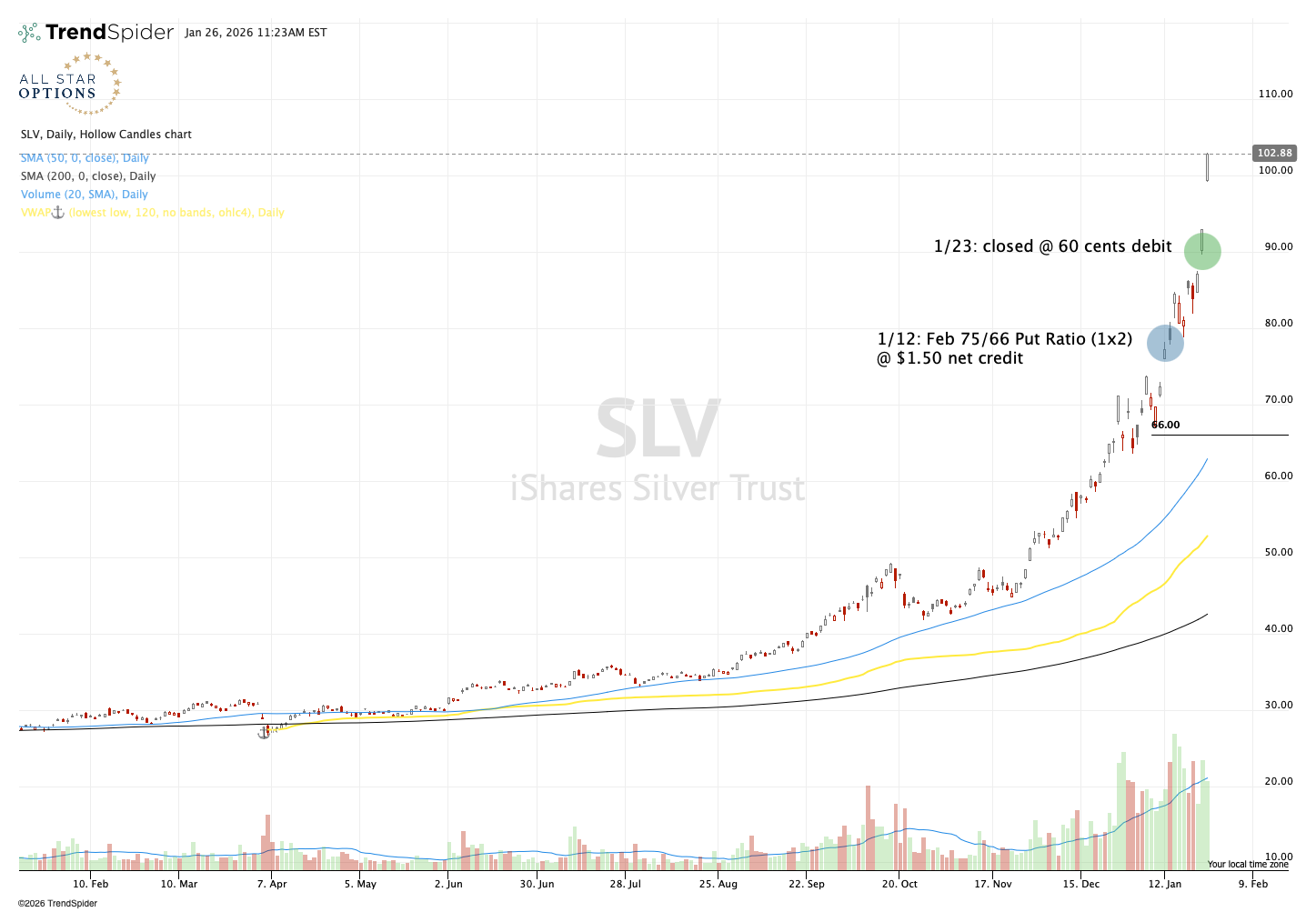
A couple weeks ago, I put on a bearish trade in SLV—a February 75/66 put ratio spread. This involved selling one 75 put to finance the purchase of two February 66 puts.
The key detail: I put this trade on for a net credit.
My thesis was that silver was near a blow-off top and due for a pullback. I wanted to position for a sharp move lower without getting hurt if I was completely wrong.
Well, I was completely wrong.
SLV barely had any down days. The parabolic move higher continues unabated. Silver just keeps ripping:
But here's the beautiful part: thanks to putting this spread on for a credit, I was able to close it today for a smaller debit than the credit I received on day one.
Result? A profit.
I was dead wrong about direction. Dead wrong about timing. Dead wrong about the setup.
And I still walked away with a gain.
I wish all trades worked this way. They don't, of course. Most of the time, being wrong costs you money. That's the game.
But trades like this highlight the flexibility options trading can offer and the myriad ways we can structure positions for a variety of outcomes.
Think about what happened here: I entered bearish, collected a credit upfront. The stock moved against my thesis—significantly. But because of how the trade was structured, time decay and volatility expansion worked in my favor enough to close it profitably despite being directionally wrong.
This is what people mean when they talk about options giving you multiple ways to win.
A straight put buyer in this scenario? Crushed. The puts would have lost value as SLV continued higher.
But the put ratio spread, entered for a credit, had built-in protection. Even as my bearish thesis failed to materialize, the structure allowed me to exit without taking a loss.
Does this mean put ratio spreads are magic? No. They have their own risks. If SLV had dropped moderately and landed between my strikes at expiration, I would have taken a loss. That's the risk zone with this structure.
But the upside—both literally and figuratively—is that I had defined my risk, collected premium upfront, and created a scenario where even being wrong about the big move didn't kill me.
This is why I keep talking about having multiple tools in your toolkit. Different strategies for different setups. Different structures for different levels of conviction.
I wasn't supremely confident SLV was going to crash. I thought it might pull back. Worth positioning for, but not worth betting the farm on.
So I structured a trade that would profit handsomely if I was right, but wouldn't devastate me if I was wrong.
Turns out I was wrong. And I'm fine. Better than fine—I made money.
That's the power of thoughtful structure over pure directional bets.
Could I have made more if I'd been bullish and bought calls? Absolutely. But I wasn't bullish. My read was bearish. I positioned accordingly with a structure that limited my downside while still giving me exposure to my thesis.
The market proved me wrong. The structure saved me anyway.
This is what sophisticated options trading looks like. Not predicting perfectly. Not being right all the time. But structuring trades in ways that allow you to survive—and sometimes profit—when your thesis doesn't play out.
I'm not celebrating this as some brilliant trade. I was wrong. I know that.
But I'm acknowledging that the trade structure worked exactly as designed. It gave me exposure to a bearish move while protecting me if that move never came.
And in this case, it even managed to eke out a small profit despite the stock doing the opposite of what I expected.
Not every strategy offers that kind of forgiveness. Not every structure lets you be wrong and still walk away whole.
But when you understand the mechanics of different options strategies—how they respond to price movement, time decay, and volatility changes—you can build positions that have multiple ways to win.
Or at least multiple ways to not lose.
SLV taught me a lesson this time: sometimes the best trade isn't the one where you're brilliantly right. It's the one where you're wrong and the structure saves you anyway.
Want to learn how to structure trades with built-in protection? All Star Options teaches not just what to trade, but how to construct positions that can survive being wrong. Join us and discover the flexibility that comes from understanding options mechanics.
Sean McLaughlin | Chief Options Strategist, All Star Charts
--> If you'd like to receive these notes in your email, sign up here.