
When Crypto Becomes Invisible

As the year winds down, I’ve headed to Hawke’s Bay in New Zealand to spend Christmas.
It’s a region known for incredible produce and wine, and at this time of year the weather is warm and sunny. Yesterday, I went to the Sunday farmers market to stock up for the week ahead. My dad, who hadn’t been in years, asked a simple question:
“Did you bring cash?”
Surely they take card, I thought.
And because it’s 2025, of course they did.
What might surprise you is that New Zealand was, in practice, one of the first countries to go largely cashless. That only happened because the major banks collaborated early, reduced friction in electronic payments, and made the system so seamless that most people never had to understand how EFTPOS actually worked.
That’s the key point.
For any technology to scale meaningfully, the complexity has to disappear.
The internet didn’t truly take off until browsers hid the technical plumbing underneath. Before that, it was clunky, confusing, and inaccessible to most people.
Crypto has been stuck in that pre-browser phase.
Seed phrases. Wallets. DeFi protocols. For the average person, it’s overwhelming, like trying to use the internet without Chrome or Safari.
But that’s changing.
Heading into 2026, stablecoins are projected to process more volume than ACH.
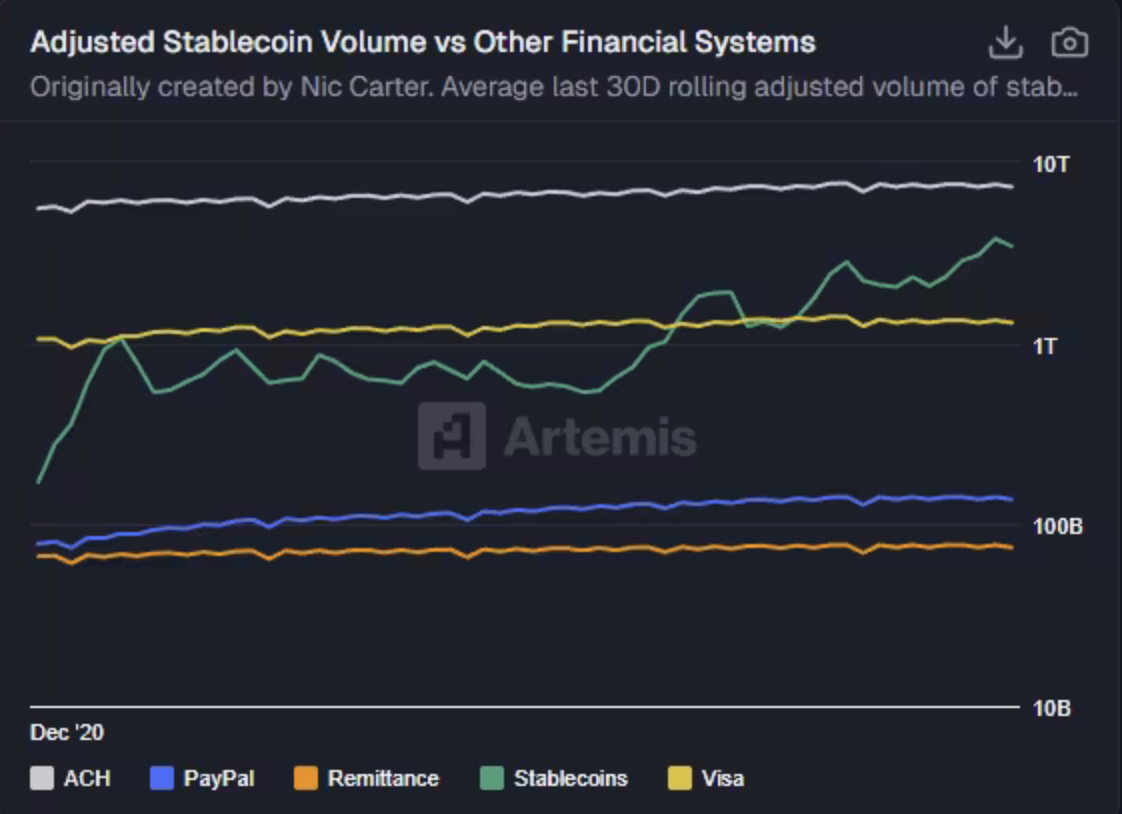
In a few years, you’ll be paying for everyday items without even realizing you’re transacting in stablecoins or that your purchase is being settled on a crypto network.
The interface will look familiar. The rails underneath will be entirely new.
This weekend, the CEO of one of the largest DeFi lenders said, “DeFi is dead.”
Not because it’s failing, but because it’s succeeding.
In the near future, institutions won’t distinguish between DeFi and TradFi at all. Capital markets activity will simply move onchain, and the labels will stop mattering.
Here’s my prediction: over the next decade, crypto will stop being treated as a separate “asset class” altogether.
Instead, it will be absorbed into the technology and financial stack of the global economy, no different from cloud computing, databases, or payments infrastructure. We won’t talk about “owning crypto” any more than we talk about owning TCP/IP or SQL. The value will accrue to the companies, platforms, and networks that make this technology usable, scalable, and invisible.
And when that happens, crypto won’t feel like crypto anymore.
It’ll feel like tapping your card at a farmers market: without cash, without friction, and without thinking twice about how it works.
From the beautiful Hawke's Bay,
Louis Sykes
Senior Crypto Analyst, All Star Charts