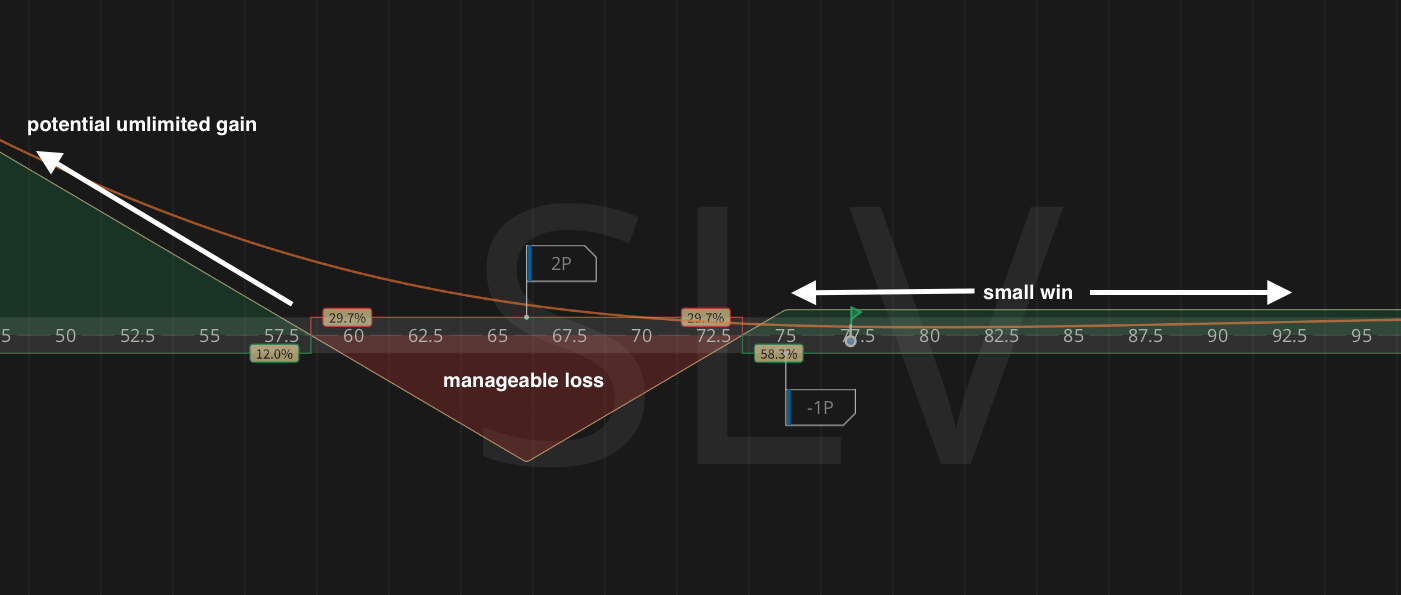
Yesterday, I put on a type of options trade I don't do a lot of—a put ratio spread.
For those unfamiliar, a put ratio spread involves selling one slightly out-of-the-money put while buying two (or more) puts at a further out-of-the-money strike. When structured properly, you can enter this trade for a small credit or minimal debit.
The beauty of the setup: if the underlying drops hard, those long puts start printing. The profit potential accelerates as the stock falls because you're long more puts than you're short. But if you're wrong and the stock stays flat or goes higher, you collect a small credit and nothing happens.
Your risk is defined and occurs if the stock drops moderately—landing between your short strike and your long strike at expiration. That's where you take a loss. But if the stock absolutely crashes below your long put strikes, you're actually net long puts, which means unlimited profit potential as it continues falling.
I did it in SLV:
My bet is we may be near a blow-off top and I'd like to catch the turn, but not be harmed if I'm dead wrong.
The precious metals have had an incredible run. Silver especially. But nothing goes straight up forever. I'm looking for a pullback, potentially a sharp one. The put ratio spread lets me position for that scenario with favorable risk-reward.
If silver keeps ripping higher? I collect a small credit and move on. No harm done.
If silver pulls back modestly? Small loss, well-defined, acceptable.
If silver gets crushed? That's where this structure shines. The profit accelerates as it falls.
It's not a strategy I use very often. In fact, I didn't use it once in 2025. But the time feels right in this particular situation.
Sometimes it's good to break up the routine, stretch our muscles, and try new things.
I spent 2025 mastering certain strategies—calendar spreads, vertical spreads, naked calls and puts. Those became my bread and butter. They generated a 108% return on a 41% win rate in the All Star Options model account.
But markets change. Conditions evolve. What worked beautifully in one environment might be less effective in another.
The edge isn't in knowing one strategy perfectly. The edge is in having multiple tools and knowing when to deploy each one.
I could force my usual approaches onto this SLV setup. Buy calls if I think it's going higher, buy puts if I think it's going lower. But neither of those felt right. The implied volatility (or expensiveness) of the options is too high. Plus, the uncertainty about timing the turn, combined with the possibility of continued upside, made a directional bet less appealing.
The put ratio spread gives me optionality. It lets me be wrong without getting hurt, while positioning for the scenario I think is most likely—a sharp pullback after an extended run.
This is the flexibility that matters. Not being married to any single approach. Not forcing your favorite strategy onto every setup. Recognizing when conditions call for something different.
Maybe this SLV trade works. Maybe it doesn't. But I'm comfortable with the structure because it fits the specific scenario I'm positioning for.
And honestly? It feels good to dust off a strategy I haven't used in a while. Stretching different muscles. Thinking through setups from a different angle.
That's how you grow as a trader. Not by doing the same thing over and over, but by expanding your toolkit and knowing when to reach for different tools.
If you only know how to trade bull call spreads, what do you do in a bearish market? If you only know how to sell premium, what happens when volatility collapses? If you only trade one style, you're at the mercy of whether current conditions favor that style.
But if you can shift strategies based on what the market is offering? You're never out of the game.
2025 was dominated by certain strategies because those strategies matched the conditions. 2026 might be different. I want to be ready.
So I'm staying flexible. Trying things. Getting uncomfortable with structures I haven't used recently.
That's how edges are maintained. Not by perfecting one approach, but by remaining adaptable to whatever the market throws at you.
Want to learn how to deploy different options strategies based on market conditions? All Star Options teaches not just individual trades, but how to think about which strategies work best in different environments. Join us and expand your toolkit.
--> If you'd like to receive these notes in your email, sign up here.
Sean McLaughlin | Chief Options Strategist, All Star Charts