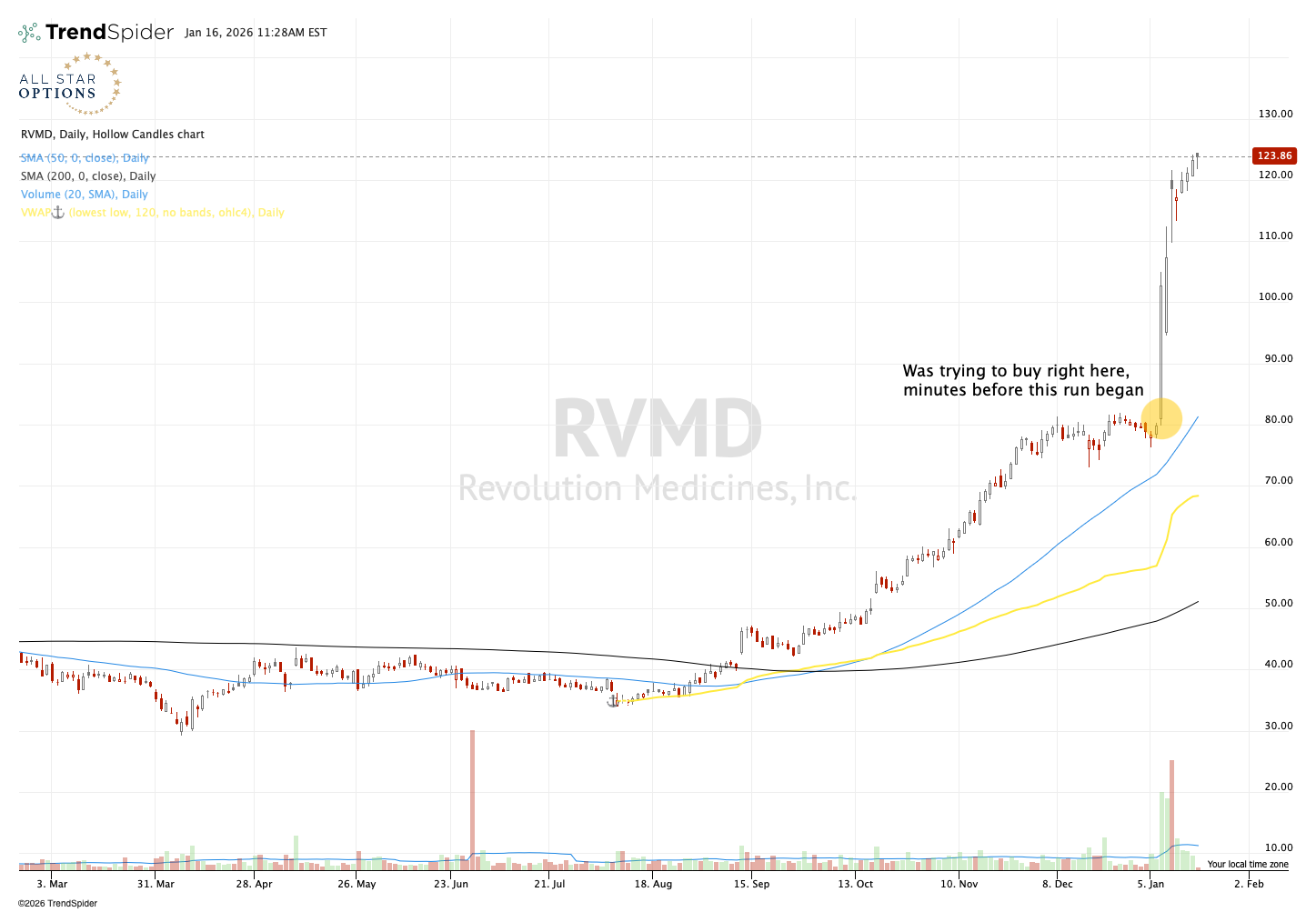
On January 7th, I was attempting to buy RVMD February 85 calls when the stock was trading around $82-83 per share. The bid-ask spread was wide—in the neighborhood of $3.20 bid, $3.70 offered.
I placed my initial bid at $3.25 to see if there were any takers. There were none. So I quickly improved my bid price to $3.30. After a few minutes, I increased again to $3.40. By this time, the offer had lifted a bit, so I improved my price one more time to $3.50.
Still no takers.
I'm haunted by the fact that had I initially put my bid in at the mid-price ($3.45) from the very start, I likely would have been filled.
Instead, I had no position when, about five minutes after my last price improvement, news hit the tape and the stock absolutely took off—without me in it:
Today, seven trading days later, the stock trades around $123 per share.
Those February 85 calls I was trying to get for $3.50? They're currently worth about $38 per contract.
More than 10x where I was trying to get in.
Let that sink in for a moment.
I relate this story because I talk constantly about working orders, using limit orders, and not paying the spread when entering options positions. This is a best practice that serves me well 99% of the time.
But every so often, my prudence keeps me out of a truly great trade.
This is one of those times.
Here's what makes this particularly frustrating: I did everything I'm supposed to do. I didn't chase. I didn't panic buy. I worked my price methodically, improving my bid incrementally to see where I could get filled.
I was patient. I was disciplined. I followed my process.
And I missed one of the best trades of the year so far.
The what-ifs are killing me. What if I'd just paid $3.45 from the start? What if I'd been willing to pay $3.60 or even $3.70 to secure the position?
Twenty-five cents. That's the difference between being in this trade and watching it from the sidelines. Twenty-five cents on a trade that's now up more than 10x.
But here's the brutal truth: I can't trade this way.
If I start paying the offer on every setup I like, I'll get worse fills across hundreds of trades. Those extra quarters and half-dollars add up. Over time, paying spreads instead of working orders costs real money.
The discipline that kept me out of RVMD is the same discipline that's saved me thousands of dollars in execution costs over the years.
So which is right?
Both. Neither. It depends.
This is the impossible calculus of trading. The same behavior that protects you most of the time occasionally costs you. And you never know which scenario you're in until it's too late.
If I'd known news was coming in five minutes, of course I would have paid the offer. But I didn't know. Nobody did. That's why it's called trading and not knowing.
I'll be honest—missing trades like this hurts me more than any losses I take.
Losses are part of the game. I expect them. I plan for them. I size positions knowing some will go to zero.
But missing a 10-bagger because I was trying to save twenty-five cents? That's a different kind of pain.
It's the opportunity cost. The what-could-have-been. The knowledge that I was right about the setup, right about the timing, right about everything except the execution.
I'm bummed. Really bummed.
But I'll get over it. Eventually.
Here's what I won't do: I won't change my process because of one missed trade. I won't start paying offers on every position just because this one got away.
That's how you blow up a good process. You let one outlier event—good or bad—convince you to abandon what works most of the time.
Yes, I missed RVMD. Yes, it hurts. Yes, I'll be thinking about those $38 calls for a while.
But I've also saved thousands of dollars by working orders instead of paying spreads. Those savings don't show up on a highlight reel, but they're real.
This is trading. Nothing is easy. Nothing ever will be.
You make the best decision you can with the information you have at the time. Sometimes you win big. Sometimes you lose. And sometimes—like now—you do everything right and still miss.
The only thing worse than missing this trade would be letting it change my approach on the next hundred trades.
So I'll take my lump. I'll acknowledge that my discipline cost me this time. And I'll keep working orders on the next setup, knowing that over time, the math works in my favor.
Even when it doesn't feel like it.
RVMD is gone. That opportunity is over. But there will be others. There always are.
The traders who survive long enough to catch them are the ones who don't blow up their process because of what got away.
Sean McLaughlin | Chief Options Strategist, All Star Charts
--> If you'd like to receive these notes in your email, sign up here.