Everyone's Mad About Canton. Good.

Yesterday I wrote about why privacy, not regulation, is the real barrier to institutional crypto.
Today I want to talk about the chain that's actually solving that problem, and why the last 48 hours have been a turning point.
I've been watching Canton since it launched. Built a position early. Talked about it when almost nobody in the crypto media was paying attention. For months, if you brought up Canton in a crypto discussion, you'd get blank stares or a dismissive "that's not real crypto."
Then Visa announced it was joining Canton as a Super Validator this week. First major payments company to take a governance role on the network. Not a partnership press release or an "exploring blockchain" blog post. An actual infrastructure commitment to help banks bring payments onchain.
And suddenly, everyone has an opinion about Canton.
The Ethereum and Solana maximalists have come out swinging. They hate Canton. They think it's antithetical to crypto because it has privacy built in and it's not fully transparent the way their chains are.
They're angry that a blockchain designed not just for crypto natives doesn't broadcast every transaction to the entire world.
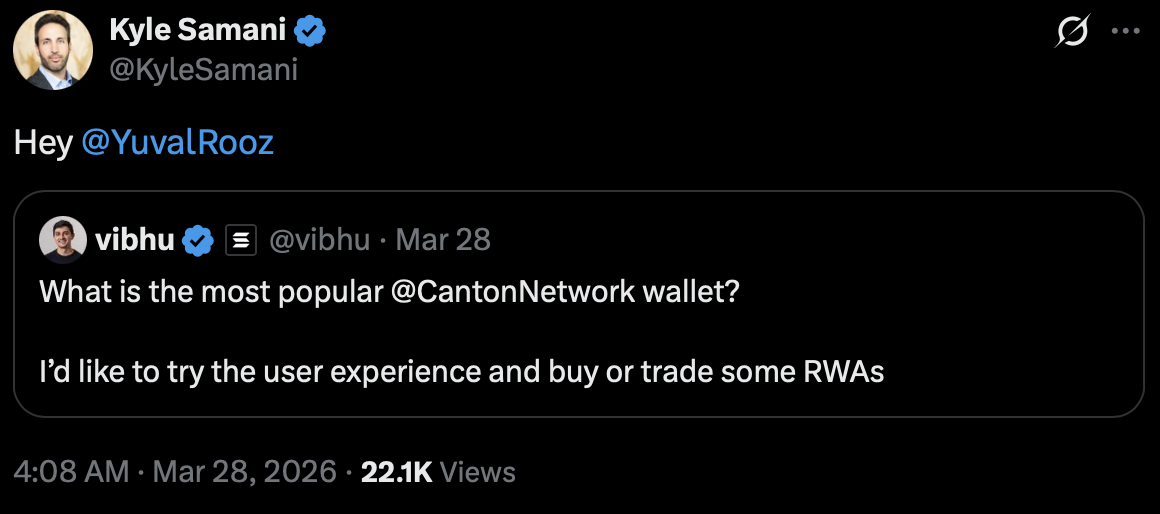
Here's Kyle Samani, the poster child of Solana, being facetious about how Canton "doesn't have a retail venue to trade real world assets".
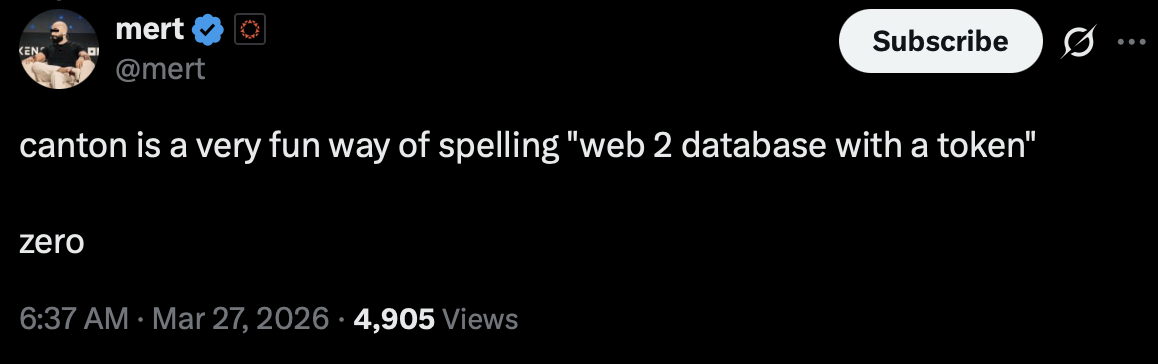
Here's the CEO of Helius, a major Solana data firm, saying Canton is worthless.
And here's the founder of ZKSync putting out a long winded argument about how Canton doesn't effectively deliver privacy. It got over 170,000 views in a single day.
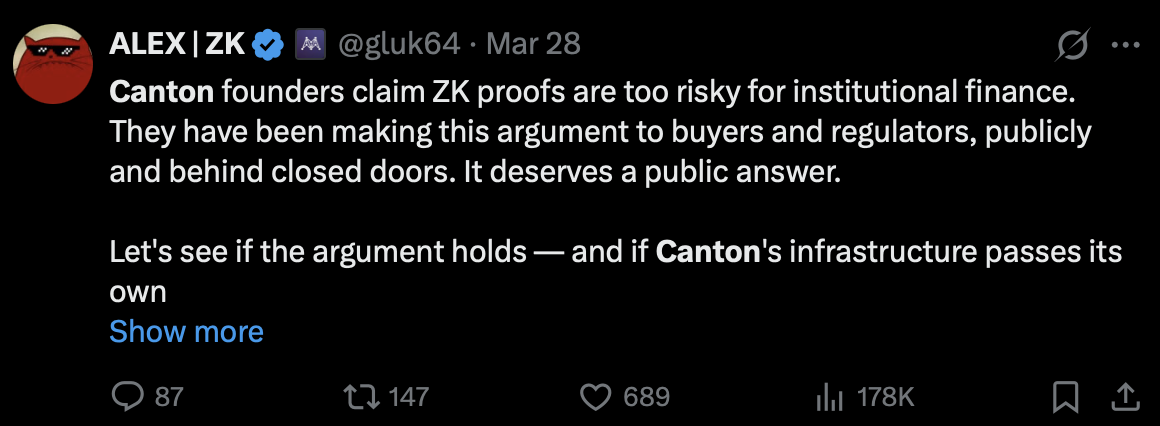
The attention is flattering. But the criticism tells on itself.
If Ethereum or Solana were better at delivering this technology to the institutions that actually matter, wouldn't they be the ones getting chosen?
They're not.
Broadridge Financial wouldn't be settling its entire daily repo flow on Canton if Solana could do the job.
JP Morgan wouldn't have selected Canton to settle $5T if Ethereum had the architecture.
DTCC wouldn't be tokenizing US Treasuries on Canton if any other chain could offer privacy, interoperability, and auditability in a single stack.
These institutions didn't pick Canton because they're confused about crypto. They picked it because they evaluated every option and the others couldn't meet the requirements.
The institutions that actually move the world's money don't care about your philosophical purity test. They care about whether their competitors can see their order flow. They care about whether their collateral positions are public information. They care about whether regulators and auditors can access what they need without the entire market watching.
Canton was built for those customers. Ethereum and Solana were not.
And with all this hate, I love the trade even more.
Canton sits at roughly $5 billion. Solana is around $50 billion. Ethereum is north of $250 billion.
Canton already generates more transaction fees than both of them.
And the crypto crowd thinks it's not a real blockchain because you can't see what Goldman's bond desk is doing.
Every time a new technology threatens an incumbent's worldview, the first response is ridicule. That's what this backlash is. The Ethereum and Solana communities see an existential challenge to the idea that their chains are where all of finance ends up, and they're coping with it by calling Canton fake crypto.
Tokenization isn't coming. It's here. And the chain winning the actual institutional contracts, not the Twitter arguments, is Canton.
We're so early.
We've covered a lot this week in the crypto markets.
On Monday, I said that if you're investing in crypto, you need to own something real. 99% are fake and 1% are real assets worth owning.
On Tuesday, I outlined how the world's largest consulting firms are anticipating a 1,000x gain in this one industry.
This is the biggest area I'm exposed to in my personal trading account.
On Wednesday, I broke the biggest lie the mainstream media is telling you over the Clarity Act.
It's more complicated than they are letting on.
On Friday, I let you know that from next year onwards, every single crypto transaction you make will be getting reported to tax authorities.
You need to know how new CARF regulations will impact you.
And yesterday, I argued that regulation isn't crypto's biggest issue, it's privacy.
Enjoy your Sunday!
Louis Sykes
Senior Crypto Analyst, All Star Charts