2026's Most Important IPO is Going Under the Radar

- A 1994 Australian IPO called Computershare quietly became one of the great companies in modern market history by owning the boring plumbing of U.S. stock ownership records.
- That plumbing is about to be rebuilt on blockchain rails, and Securitize is the Netflix to Computershare's Blockbuster.
- The real opportunity isn't just Securitize itself; it's the downstream infrastructure layer that will quietly capture most of the value as tokenization becomes the default way American assets settle.
There's a company you've almost certainly never heard of that sits between you and 60% of every American stock you own.
When you buy shares through your broker, a company issues a dividend, pays out a special distribution, processes a corporate action, handles a proxy vote; this company is doing the boring work underneath.
It's called Computershare. It's based in Melbourne, Australia.
And when Computershare went public on the ASX in 1994, it did something almost no company in modern market history has done: it returned investors 110x their money in the first seven years alone.
A $10,000 investment at the 1994 IPO would have grown to roughly $1.1 million in just seven years.
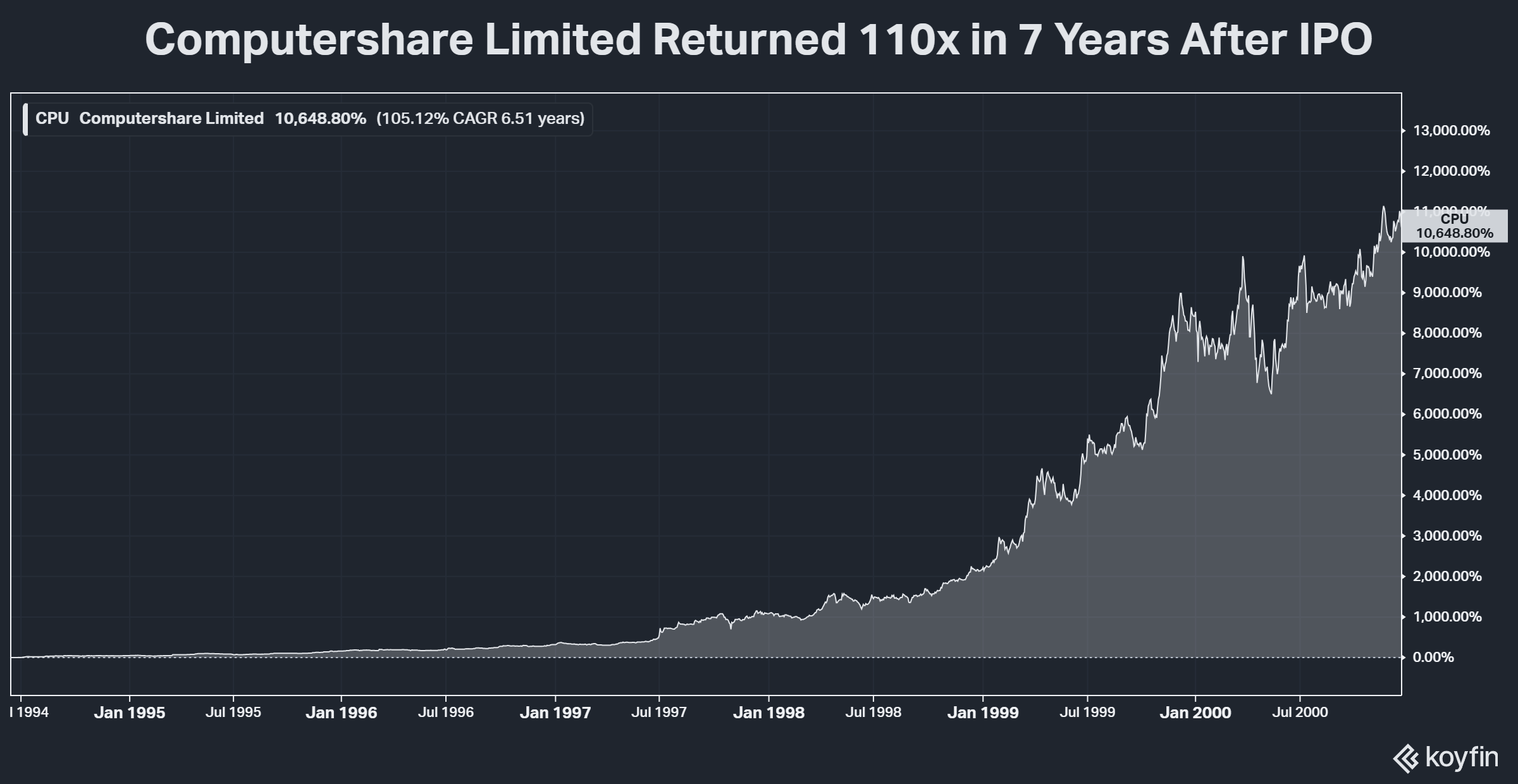
If you had held on, through the dot-com crash, the 2008 financial crisis, COVID, and every other wobble along the way, that same $10,000 would be worth approximately $89 million at its recent peak.
For context: the same $10,000 invested in a standard S&P 500 index fund over the same period would have grown to somewhere around $180,000. A very good outcome, and roughly 1/500th of what Computershare produced.
The interesting part is that the plumbing Computershare built (the registries, the ownership books, the corporate-actions infrastructure) is about to be rebuilt from scratch on blockchain rails by a new generation of companies most investors have never heard of either.
One of them is going public any day now. Its name is Securitize and it's listing on Nasdaq as SECZ. I'd suggest you pay attention, because this is the kind of structural handoff that only happens a few times per generation.
The thesis, stated plainly
Most major financial assets on earth are going to be tokenized.
This is no longer a fringe crypto position because BlackRock now runs a tokenized treasury fund, JPMorgan runs an internal blockchain settlement network called Kinexys, and the NYSE's parent company is building tokenized markets. In his April 2026 annual letter to shareholders, Jamie Dimon, who spent a decade calling Bitcoin a fraud, wrote that "a whole new set of competitors is emerging based on... tokenization"
That's the CEO of the largest bank in America telling his own shareholders that if JPMorgan doesn't get out in front of it, someone else will.
Computershare is Blockbuster. Securitize is Netflix.
Computershare's business, the one that made it a generational compounder from 1994 onward, was being the trusted intermediary in a world where ownership records had to be maintained in centralized databases, reconciled between brokers, and settled over days. It was a brilliant business for thirty years, because the alternative was chaos.
Tokenization compresses some of those intermediary roles.
When a share of Apple exists as a token on a blockchain, the record is the asset. There's no separate ownership book to reconcile. The share can trade 24 hours a day and carry programmable rules like dividend rights, voting rights, lockup periods embedded in the token itself.
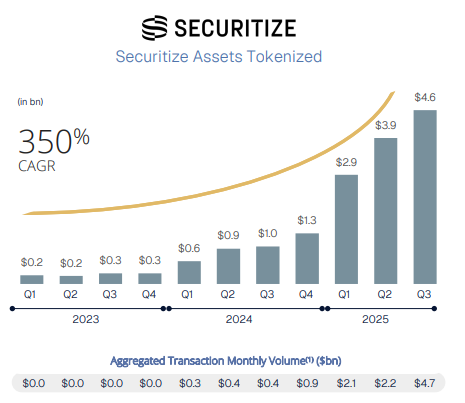
As of late 2025, Securitize had already handled over $4 billion in tokenized assets, including the tokenization of BlackRock's bond fund, but this number is going to balloon.
Why this is the trade of the decade, and why almost nobody will take it
Here's what I think is going to happen in the next three years.
Securitize lists and the financial press finally has a pure-play tokenization name to cover, so every business outlet runs the story. SECZ becomes the name every retail investor associates with tokenization, the way MicroStrategy became the name for "crypto exposure via an equity" in a previous cycle.
Some investors will do well buying Securitize. Others will get chopped up in the volatility that always surrounds a new public crypto-adjacent name, particularly one arriving via SPAC.
But here's the part most will miss.
Tokenization is not one company, it's an entire stack. Issuance platforms like Securitize are one layer. Underneath and around them sit the custodians, the exchanges, the settlement blockchain networks, the oracle providers, the payment rails that connect tokens to dollars, the equity brokerages that will have to integrate on-chain assets into their existing platforms.
Most of the value in a technology transition doesn't accrue to the most famous name. It accrues to the unglamorous businesses that end up being touched by every transaction, the Computershare's of the new system.
Some of those businesses and networks are already public. Some are about to be. A few of them are trading at valuations that don't yet reflect what happens when tokenization goes from a $4 billion niche to the default way American stocks and bonds settle, which Nasdaq and the NYSE have both publicly signaled is coming by the end of this decade.
That's what I spend my time looking for. The downstream beneficiaries that will become indispensable.
If you've been burned by crypto before
I want to say something nobody in this industry will say out loud: it wasn't your fault.
You were told a story in the last cycle about institutional adoption, about Wall Street coming on-chain, about crypto becoming the rails for real finance. And then it didn't happen and you were left holding the bag for a future that hadn't arrived yet.
The story you were sold in 2021 is the story that's actually playing out in 2026. The difference is that this time, it isn't being built by founders with anon profile pictures and leveraged 20 year olds, it's being built by real institutions.
That is a materially different setup. And the people who understood the thesis in the last cycle, and got punished for being too early, are the exact people best positioned to get this one right.
What to do with this
Every week I cover this story as it develops, including the pure-play names like Securitize, the downstream infrastructure plays most investors will overlook, the catalysts that will tell us whether the thesis is accelerating or stalling, and the specific setups I'm watching.
I'm also talking to the people actually building this who know which rails are going to win.
By clicking on this report, I've added you to my mailing list to get regular updates on this major investment theme.
Most investors are going to wake up late to this transition.
You won't.
Best,
Louis Sykes
Senior Crypto Analyst, All Star Charts