Home Depot just gave the bulls a small win, but the broader consumer discretionary trend is still flashing a warning.
May 20, 2026
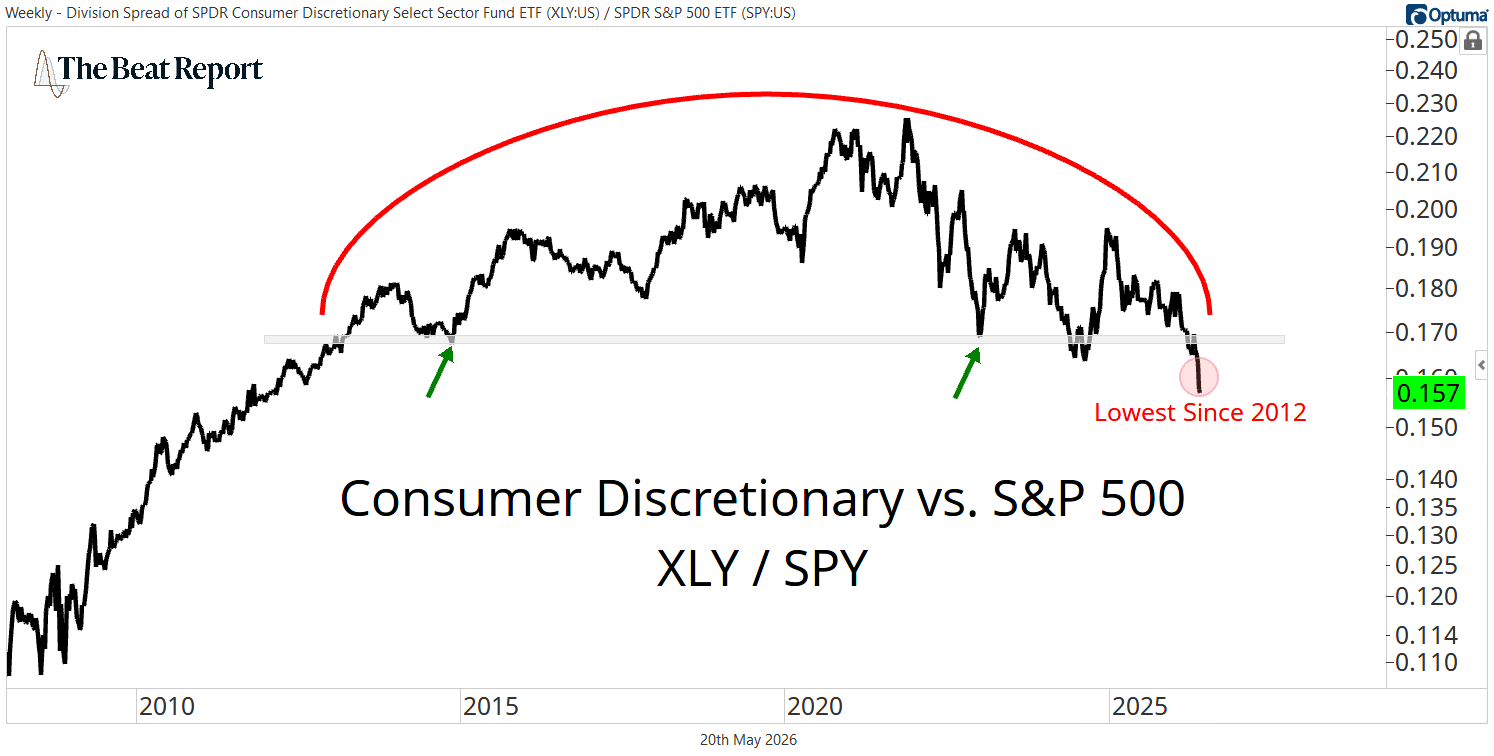
The S&P 500 has been pressing to record highs, but the consumer discretionary sector is trading at its lowest level relative to the broader market since 2012.
This is a major warning from one of the most economically sensitive corners of the equity market.
When consumers are strong, discretionary stocks tend to participate.
And when consumers are stretched, they tend to lag.
Right now, the market is telling us the consumer is weak.
Consumer Discretionary $XLY has spent years carving out a massive distribution pattern relative to the S&P 500 $SPY, and now it is decisively resolving lower.
If this is going to remain a healthy bull market, this is the kind of breakdown that needs to reverse quickly.
As the legendary market technician Ralph Acampora said, "Sector rotation is the lifeblood of a bull market."
And right now, some sector rotation into consumer discretionary is a need, not a want, for stock market bulls.
Why?
It's very difficult to make the case for broad economic strength when consumer discretionary is collapsing to multi-decade relative lows.
And that brings us to Home Depot $HD...
Home Depot is one of the most important consumer discretionary stocks in the world, trailing only Amazon $AMZN and Tesla $TSLA in sector weight.
It is also a direct window into housing, remodeling, big-ticket consumer spending, and the health of the American homeowner.
So when Home Depot starts breaking down, we pay attention.
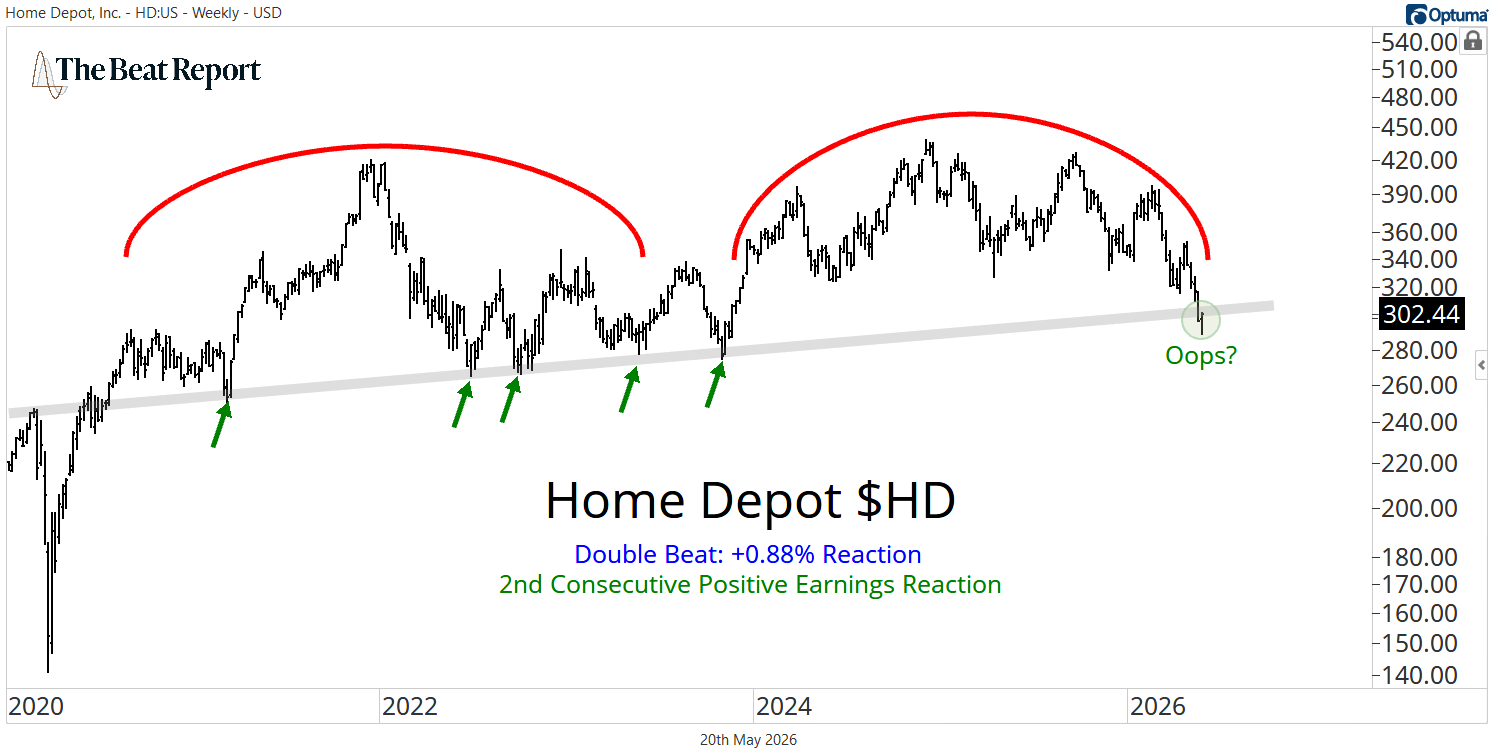
As we wrote in Sunday’s Weekly Beat, HD has spent the past several years respecting a rising support line that repeatedly caught declines and kept the longer-term structure intact.
Every time the stock came back to this level, buyers stepped in.
And now, HD is testing that line again.
The difference this time is that HD is sitting near a fresh 52-week low, momentum has been weak, and the broader consumer discretionary sector is already breaking down relative to the S&P 500.
That adds significance to yesterday's earnings reaction.
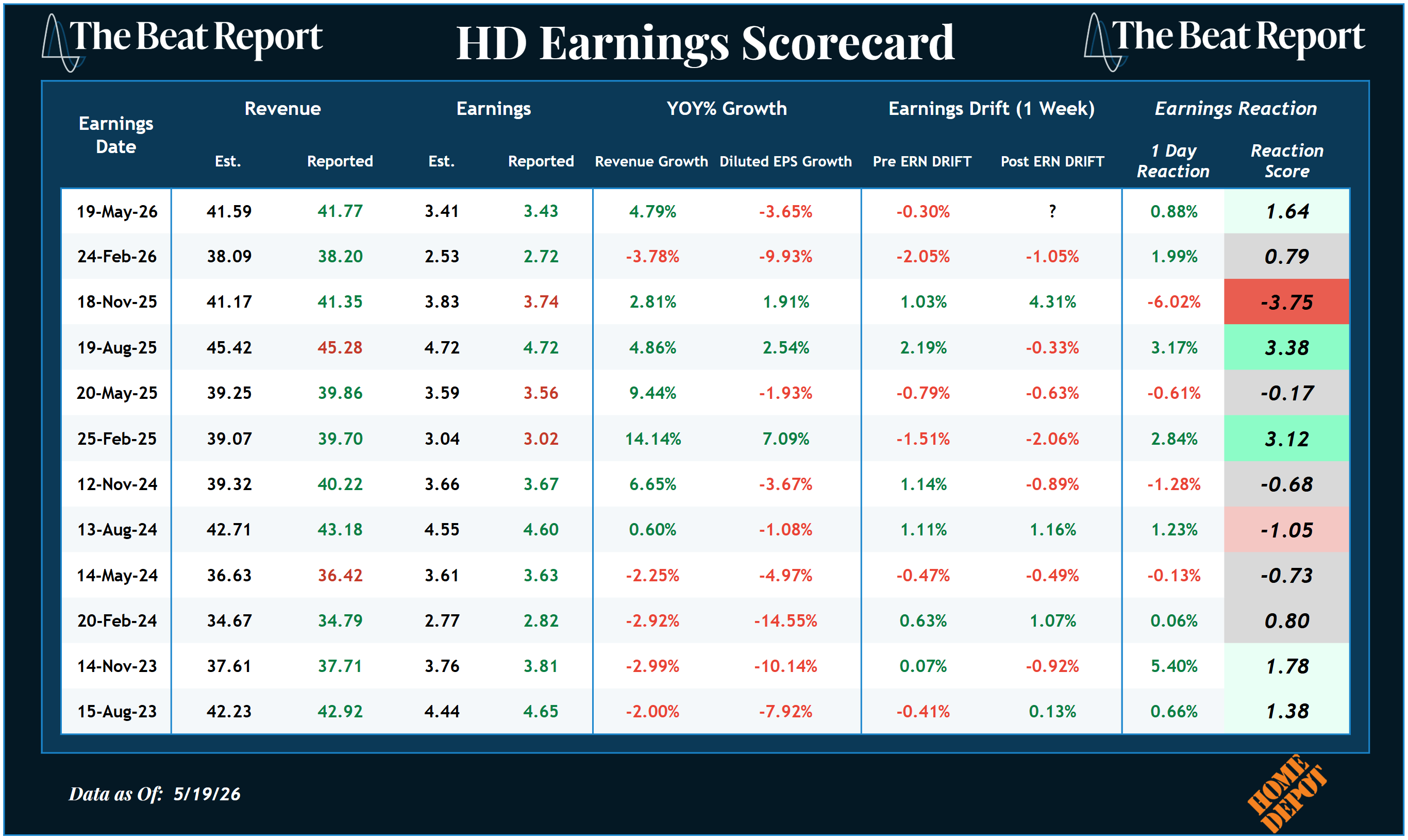
On the surface, Home Depot gave the bulls a small win as the company reported a double beat and rallied +0.88% in response.
It wasn't a monster move, but it was enough to mark the stock’s 2nd-consecutive positive earnings reaction.
More importantly, it came on a day when the S&P 500 finished lower for the 3rd-consecutive session, which pushed Home Depot’s reaction score to +1.64.
A modest gain on a weak tape is better than it looks. It tells us the market was willing to reward the stock, even if the absolute move was not dramatic.
The earnings scorecard also shows some improvement.
Home Depot's top-line returned to growth after last quarter’s nearly 4% YoY decline, while the earnings contraction eased from almost 10% last quarter to roughly 3.5% this quarter.
That's still not great, but it's better.
And for a stock sitting on a critical long-term support level, “better” matters.
Management still expects fiscal 2026 sales growth of 2.5% to 4.5%, with adjusted diluted EPS ranging from flat to up 4%.
That is not explosive growth, but it does suggest the business is stabilizing rather than falling apart.
The problem is that stabilization may not be enough...
HD needs to start going up if the XLY/SPY ratio is going to turn around.
And Tuesday’s reaction was a step in the right direction.
If HD can hold this rising support line and keep improving the fundamental trend, then this could be the beginning of a repair process for one of the market’s most important consumer stocks.
But if HD slips back below $300 and fails to reclaim it quickly, price is likely to make a fresh leg lower.
A breakdown in the stock would add more weight to the warning already flashing from relative weakness in consumer discretionary.
For now, the bulls are still alive.
If you want access to our highest conviction technical and fundamental trades, join our growing community at the Premium Beat Report.
Thank you for reading,
-The Beat Team
Editor's Note: Steve Strazza just pulled back the curtain on the simple system behind his short-term trading strategy.
It's the same system Steve has used to produce a +204% return on his portfolio in 30 days.