Overnight, headlines hit the tape that the United States and Iran are preparing to formally sign an interim peace agreement that would reopen the Strait of Hormuz and begin a new round of nuclear negotiations.
The market’s reaction was immediate.
Oil sold off.
Traders saw the words “peace deal” and assumed the energy crisis was over.
I’m not so sure.
The problem with financial markets is that they often confuse a headline with reality.
The reality is that physical commodity markets don’t normalize overnight.
They normalize over months.
Sometimes years.
And the charts tell a very different story than the one currently being priced into oil.
Inventories Are Still Collapsing
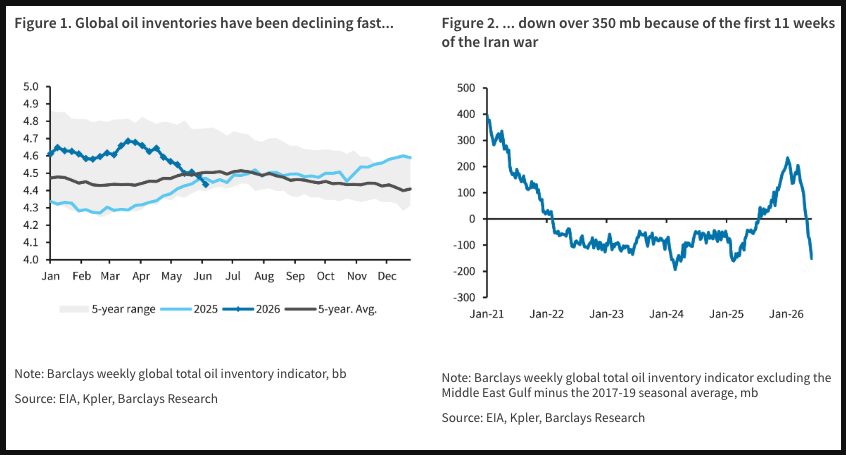
Take a look at the first chart.
Global oil inventories have been falling rapidly throughout 2026 and now sit well below normal seasonal levels.
More importantly, according to Barclays, the first eleven weeks of the Iran conflict resulted in a staggering 352 million barrel decline in global oil inventories.
That’s shown clearly in the second chart.
Think about that for a moment.
Over 350 million barrels disappeared from global inventories during the first phase of the conflict.
That isn’t a small disruption.
That’s a massive drawdown in available supply.
And inventories don’t magically reappear because politicians sign a document in Switzerland.
The Supply Problem Hasn’t Been Fixed
The bullish case for oil was never solely about the Strait of Hormuz.
It was about inventories.
And inventories remain tight.
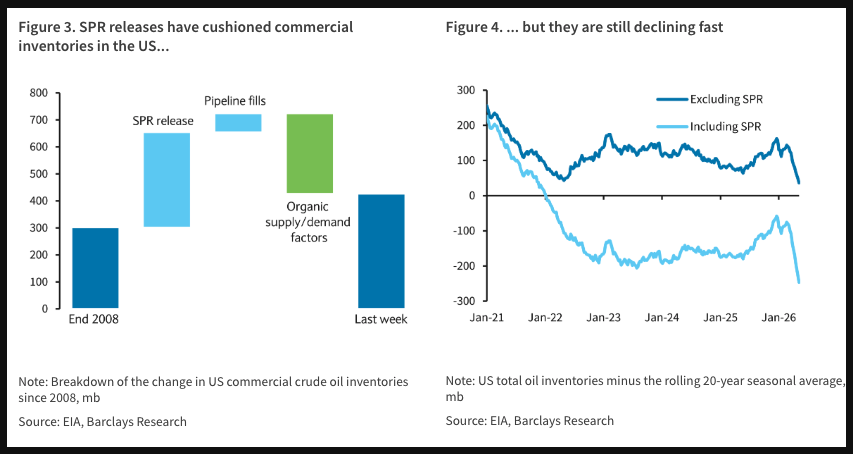
The third chart highlights something many people are missing.
A large portion of the inventory cushion in the United States came from Strategic Petroleum Reserve releases and emergency measures.
In other words, we borrowed barrels from the future.
Now look at the fourth chart.
Even including those SPR releases, inventories continue to decline at an aggressive pace.
Excluding the SPR, the drawdown is even more dramatic.
According to Barclays, U.S. commercial inventories are already below the lows reached during the 2022 energy crisis and continue falling at a pace of roughly 11 million barrels per week.
That’s not a market drowning in supply.
That’s a market running short of it.
The Commodity Cycle Is Still Alive
One of the biggest mistakes investors make is assuming a geopolitical event immediately changes a structural trend.
Sometimes it does.
Most of the time it doesn’t.
The commodity cycle has never been about a single headline.
It’s about supply, demand, inventories, and capital flows.
Those forces remain firmly in place.
Even if navigation through Hormuz returns to normal by the end of the month, inventories remain historically tight heading into peak seasonal demand.
Meanwhile, global economic activity continues to prove more resilient than many expected.
Remember, roughly 60% of oil demand comes from producing and moving goods.
As long as economic activity remains stable and inventories remain tight, the underlying setup for higher energy prices remains intact.
Don’t Confuse Headlines With Fundamentals
The market is currently acting as if reopening Hormuz instantly solves the supply problem.
The data says otherwise.
Inventories are tight.
Demand remains strong.
Physical markets are still undersupplied.
And despite the current selloff, Barclays continues to maintain a $100 Brent crude forecast for 2026.
Maybe they’re right.
Maybe they’re wrong.
But one thing is certain:
The commodity cycle is not over.
The narrative may have changed.
The headlines may have changed.
But the inventories haven’t.
And in commodity markets, inventories matter far more than headlines.
"The stock market is a device for transferring money from the impatient to the patient." Warren Buffett
The news changes every day.
Supply and demand change much slower.
That’s where I’m keeping my focus.
If you want to navigate this commodity supercycle with confidence, come join the professionals who understand how these environments work. Inside
At the Supercycle Report, we break down the biggest macro trends, commodity setups, energy trades, precious metals, agribusiness, global equities, and the exact positions we are taking in real time.
Supercycle Report highlights the breakout setups, rotations, and technical signals shaping metals markets — giving traders an edge in gold, silver, and commodities.