
We've Gone Full Circle

On July 10, the OCC gave Circle, the company behind USDC, final approval to operate as a national trust bank. On its own that reads like a dry compliance headline where another crypto firm gets another license.
But this is actually a major story: a privately-owned company just got a federal charter that lets it hold U.S. Treasuries and issue its own dollars on top of them.
If that arrangement sounds familiar, it should because it's how American money looked before in the 1800s.
The 1864 machine
When the National Banking Act was signed in 1864 and outlined the plumbing of American money. It worked like this:
- The Treasury issued debt to finance the Civil War.
- Newly chartered private banks bought that debt.
- In return, those banks were allowed to issue their own currency called national bank notes backed by the Treasuries they were holding.
The banks issued the money. The government's debt was the collateral. And the whole system was administered by a brand-new agency created specifically to charter these banks and police the currency they printed: the Office of the Comptroller of the Currency. The OCC.
So the model was: Treasury issues debt → private banks hold the debt → private banks issue currency.
Now look at what Circle just got approved to do:
- The Treasury issues debt.
- Circle buys short-term Treasuries and cash to back USDC.
- Circle issues its own dollars, USDC, one-for-one against those reserves.
Treasury issues debt → a private company holds the debt → the private company issues currency. It's the same machine. The only real difference is that the note in your pocket is now a token on a blockchain instead of a piece of paper with a bank's name printed on it.
The regulator signing off on this in 2026 is the same institution that was invented in 1863 to run the original version. The OCC was born to charter private issuers of Treasury-backed money.
The loop
The cleanest way to see this is to follow the debt–currency relationship across the last 160 years.
1864: National Banking Act. Treasury issues debt → banks hold the debt → banks issue currency. Money is private and backed by government bonds.
1913: Federal Reserve Act. The Fed is created. The debt-and-currency relationship starts migrating away from private banks toward a central authority.
1930s: Glass-Steagall. Treasury issues debt → the Fed holds the debt → the Fed issues currency. Money is now fully centralized. This is the system every one of us grew up inside. The dollar in your account is a Federal Reserve liability.
2025: GENIUS Act. Treasury issues debt → a private company holds the debt → the private company issues currency. Money goes private again.
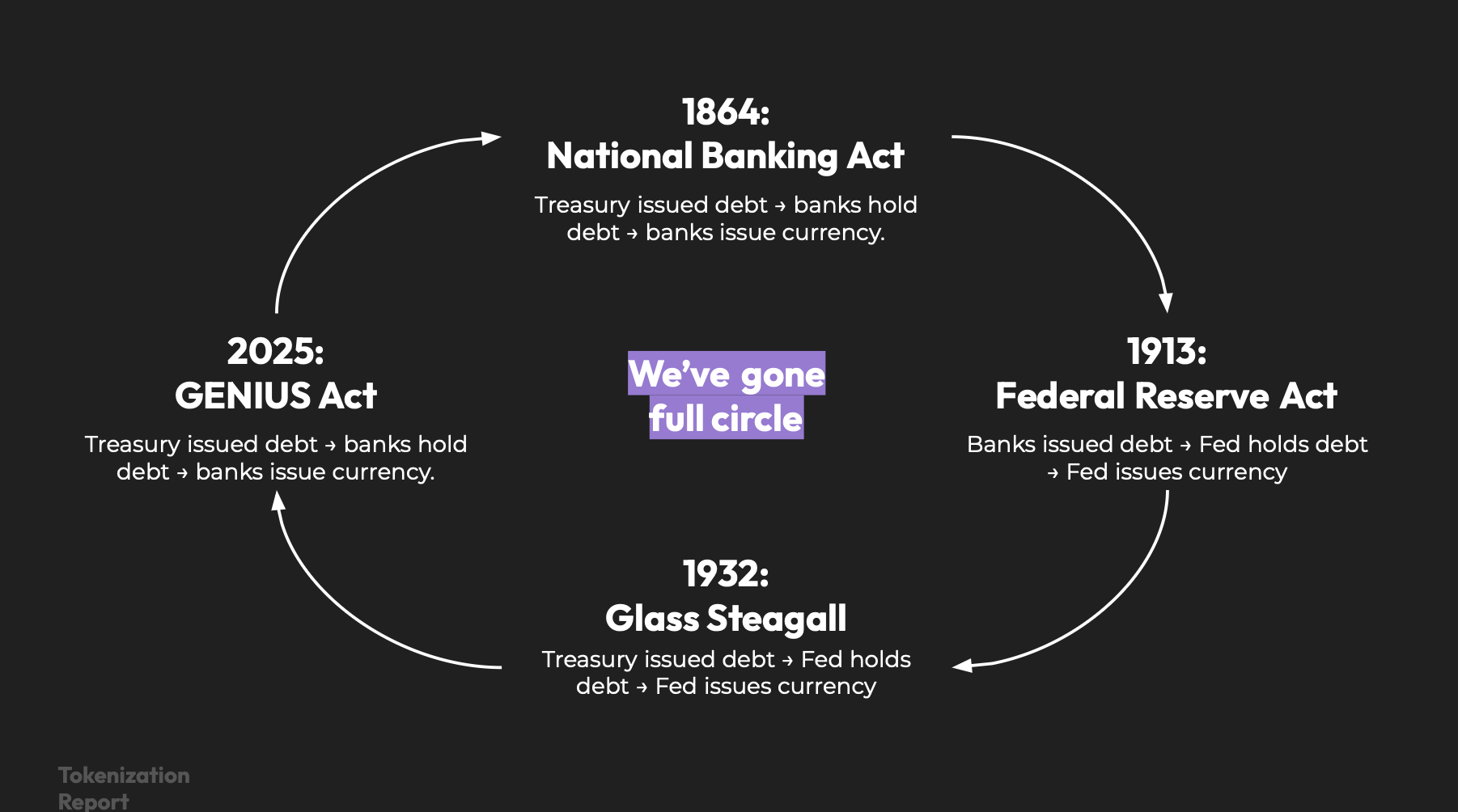
Draw those four points on a circle and the top and the bottom are the same picture. We spent a century pulling money issuance into the center, and we're now watching it walk back out to the edges to private issuers holding Treasuries, chartered by the OCC, issuing their own dollars.
Full circle.
Why this actually matters
It's tempting to file this under "neat historical rhyme" and move on. Don't because the mechanics have a real consequence.
If digital dollars become the default cash of a tokenized financial system, and every serious asset manager is building toward exactly that, then every dollar you hold in that form is a dollar backed by government debt. You wouldn't be holding cash in the old sense. You'd be holding a claim on a pile of Treasuries that a private company is managing on your behalf.
It's just what "backed one-for-one by cash and T-bills" means when you say it out loud. Under the GENIUS Act, it's the law that these dollars sit on top of short-term government paper. Officials like Scott Bessent have said the quiet part plainly that this new money will drive up demand for Treasuries. It's a feature, not a bug.
A digital dollar system turns everyone who holds the currency into a lender to Washington, mostly without them noticing.
Where this goes
I don't know how far this runs. Maybe digital dollars stay a niche settlement rail. Maybe in ten years the balance in your brokerage account are these forms of digital dollars and you never once think about the fact that it's a wrapper around T-bills held by a private company with a federal charter.
But the pathway is now visibly open, and the first institution has walked through the door. A private company holds the government's debt and issues some part of the nation's money, blessed by the same regulator that first authorized that arrangement during the Civil War.
We built this once. We centralized away from it for a hundred years. And this month we started building it again.
Full circle.
Now one thing before I go
It might look like I spend my entire day analysing the documents nobody cares to read, but every day I get out and go for walks.
This was me yesterday walking the track that's just a 10 minute walk from home. It was a beautiful day.

So I can say with full honesty that it's important to have a system that works for you so you don't need to nurse your screens constantly. And the guy I personally know who's nailed this approach is my good friend Grant Hawkridge.
He lives in Australia, plays golf, smokes cigars, and then just once a week on Monday he makes all the decisions he needs to do with his account. And just a single check a week, he manages to find major trades that can yield upwards of 5x returns.
He's kind of a bad ass for that.
So that's why I'm really looking forward to him going live next week to show it all off.
I'm gonna be there to support my other man down under, and I'd highly encourage you check out what he has to say.
You can click here to learn more and hear him out.