For decades, investors have been taught that inflation is an occasional problem. A temporary inconvenience. Something caused by supply shocks, wars, or bad luck.
I don’t buy it.
I think we’ve been on a runaway course toward stagflation since long before most of us were born.
The game changed the moment money itself became debt.
From an Austrian economics perspective, thinkers like Ludwig von Mises and Murray Rothbard argued that once money could be created through credit expansion instead of honest savings, the system became dependent on ever growing debt. Every new dollar borrowed creates an obligation to repay both principal and interest.
The only way to keep the machine running is to create even more credit.
Then governments and banks layered on new rules.
Fractional reserve banking allowed banks to lend many multiples of their actual reserves. Imagine a bank with $1 million in deposits. Instead of keeping every dollar in the vault, regulations allow it to keep only a fraction in reserve while lending the rest into the economy. Now scale that idea across institutions holding trillions of dollars and governments carrying tens of trillions in debt.
The system becomes dependent on expansion.
Eventually the debt burden grows so large that allowing widespread defaults becomes politically unacceptable. Servicing that debt through honest economic growth alone becomes nearly impossible. Central banks are pushed toward lower real interest rates, larger balance sheets, and more liquidity. Governments run persistent deficits because the alternative is painful austerity.
That doesn’t mean inflation appears overnight. It means purchasing power slowly erodes as more currency competes for a limited supply of goods, services, labor, and commodities.
Too much money eventually begins chasing too few real assets.
That’s why I spend so much time watching commodities.
Today, the market is sending an interesting message.
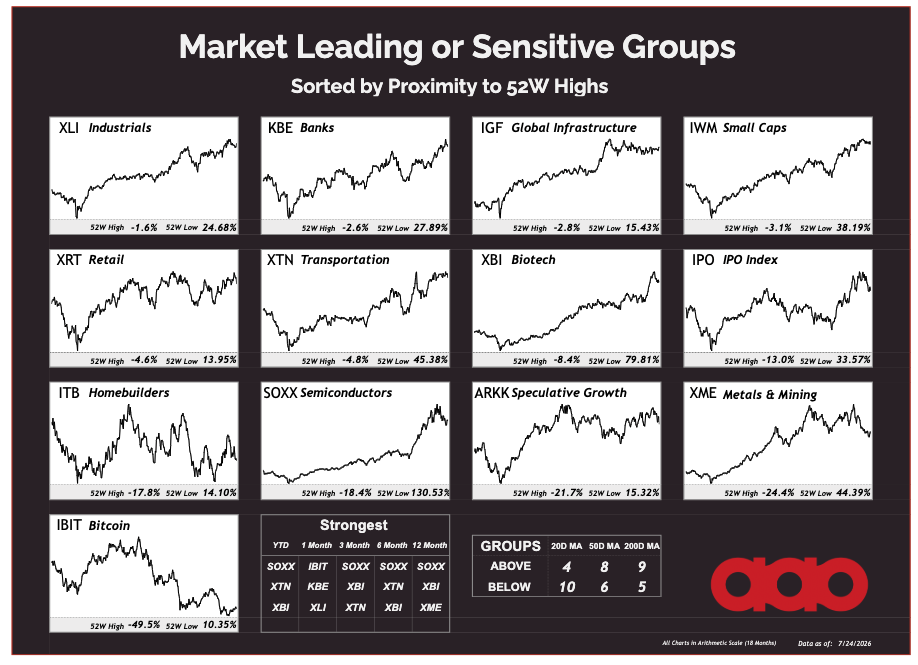
The leadership groups that normally thrive in healthy economic expansions are beginning to wobble.
Industrials remain strong, but many of the market’s most economically sensitive sectors have started losing momentum. Small caps, semiconductors, homebuilders, and speculative growth stocks are no longer leading with the same authority.
Meanwhile, energy and commodity related trades continue pushing higher.
If, over the next several months, the only groups consistently making new highs are energy producers, miners, refiners, agricultural names, and other commodity linked assets, that isn’t the profile of a booming, broad based bull market.
That’s the profile of stagflation.
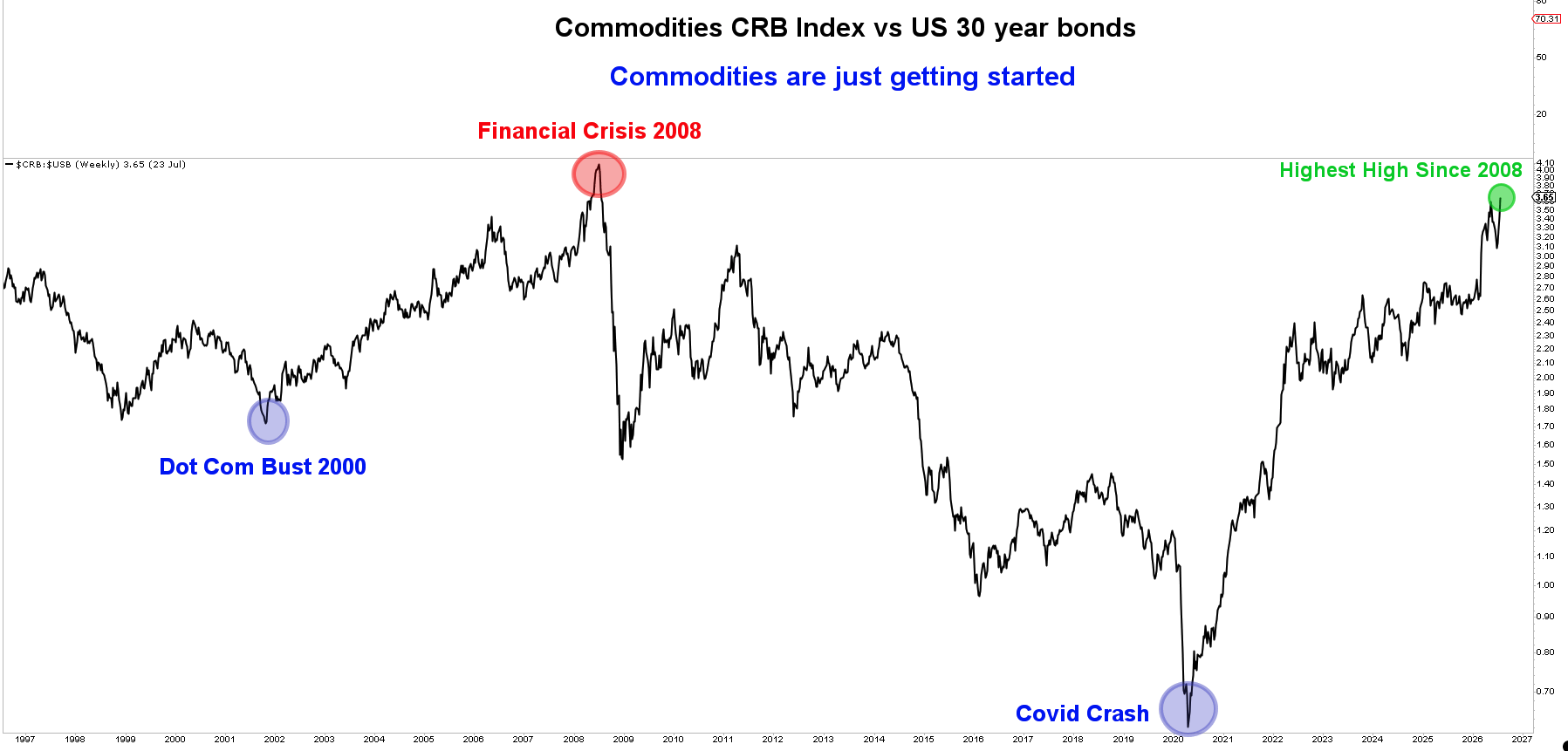
The second chart tells an even bigger story.
The CRB Index, which tracks a broad basket of commodities, continues to strengthen relative to 30 year U.S. Treasury bonds.
For nearly four decades, bonds were the place to be. Falling interest rates rewarded bondholders while commodity prices generally lagged.
Now it almost looks like commodities are finally demanding revenge.
Oil wants its turn.
Copper wants its turn.
The raw materials that power the real economy appear ready to reclaim leadership after decades of financial assets dominating the conversation.
Could this continue into a much more difficult environment for traditional stock investors? Absolutely.
But that’s not a prediction.
That’s simply the trend we’re observing.
I have no interest in arguing with the market. I don’t get paid for having the best macro narrative. I get paid for following price.
Today our portfolio is making new highs because we’re trading what is happening, not what we hope happens or fear might happen.
You can spend your life trying to predict the future.
Or you can trade the evidence that’s right in front of you.
I’ll take the second option every single time.
Sam & Jason
Want to see how we are trading the supercycle?
If you want to navigate this commodity supercycle with confidence, come join the professionals who understand how these environments work. Inside
At the Supercycle Report, we break down the biggest macro trends, commodity setups, energy trades, precious metals, agribusiness, global equities, and the exact positions we are taking in real time.
Supercycle Report highlights the breakout setups, rotations, and technical signals shaping metals markets — giving traders an edge in gold, silver, and commodities.