The Memecoin Market Is Unbeatable

- I built the cleanest memecoin dataset ever assembled, and couldn't find a single strategy that survived validation.
- Just 0.3% of wallets have ever realised $10K+ in profit, and their edge is structural (bot-speed entries, insider intent), not analytical.
- The memecoin market has an adverse selection problem which stacks the odds significantly against traders.
There's a corner of crypto where a coin can go up 8,500x in a single week.
Where a $100 bet placed on Monday morning could be worth $850,000 by Friday.
Where a new token launches every two seconds, roughly 30,000 a day, and most of them go to zero.
This is the Solana memecoin market. I spent months and thousands of dollars trying to find a systematic way to trade it.
Here's what happened.
It all started in January.
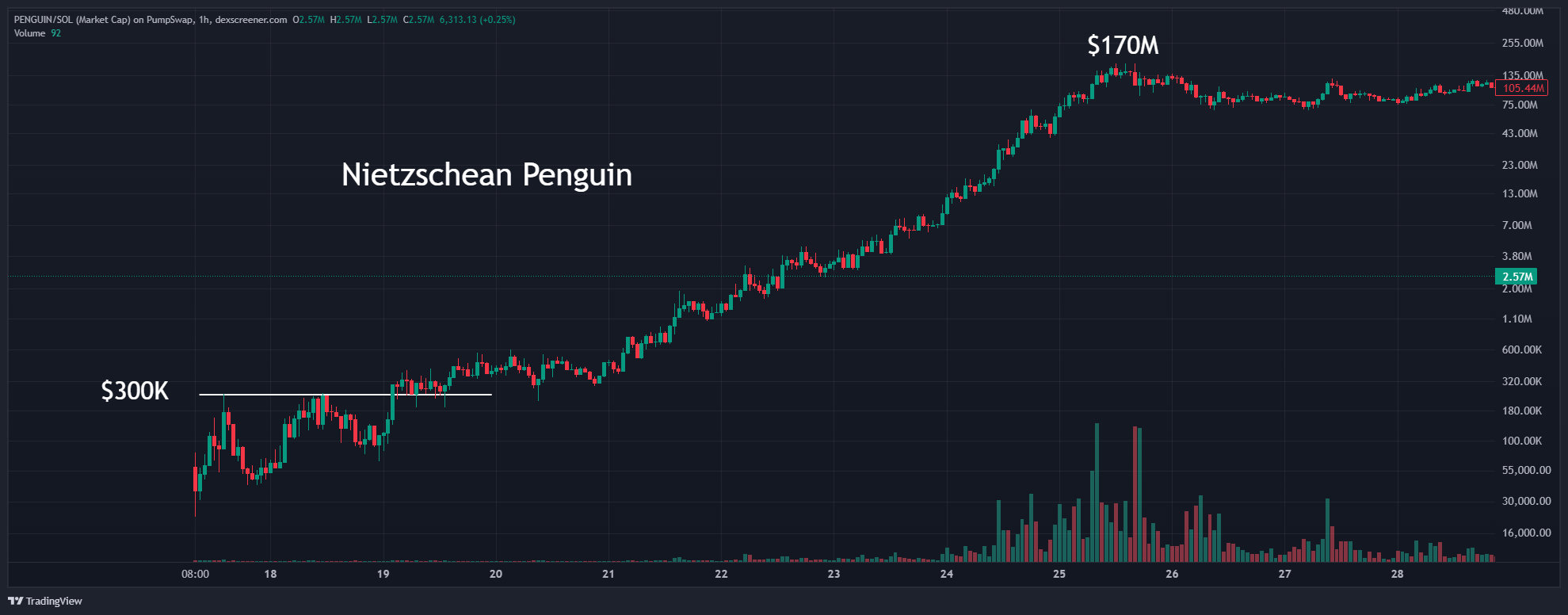
My friend Jason Kruztky, my guy I go to for anything memecoin-related, rang me up about a new coin called "Nietzschean Penguin."
It had just gone from a market cap of $20,000 to $170,000,000 in a week.
That's an 8,500x move in seven days while the rest of crypto was crashing.
I pulled up the chart and immediately saw a clean breakout pattern, the kind of setup I trade all the time in normal markets. If you'd bought that breakout at a $300,000 market cap, you were looking at a 565x return in days.
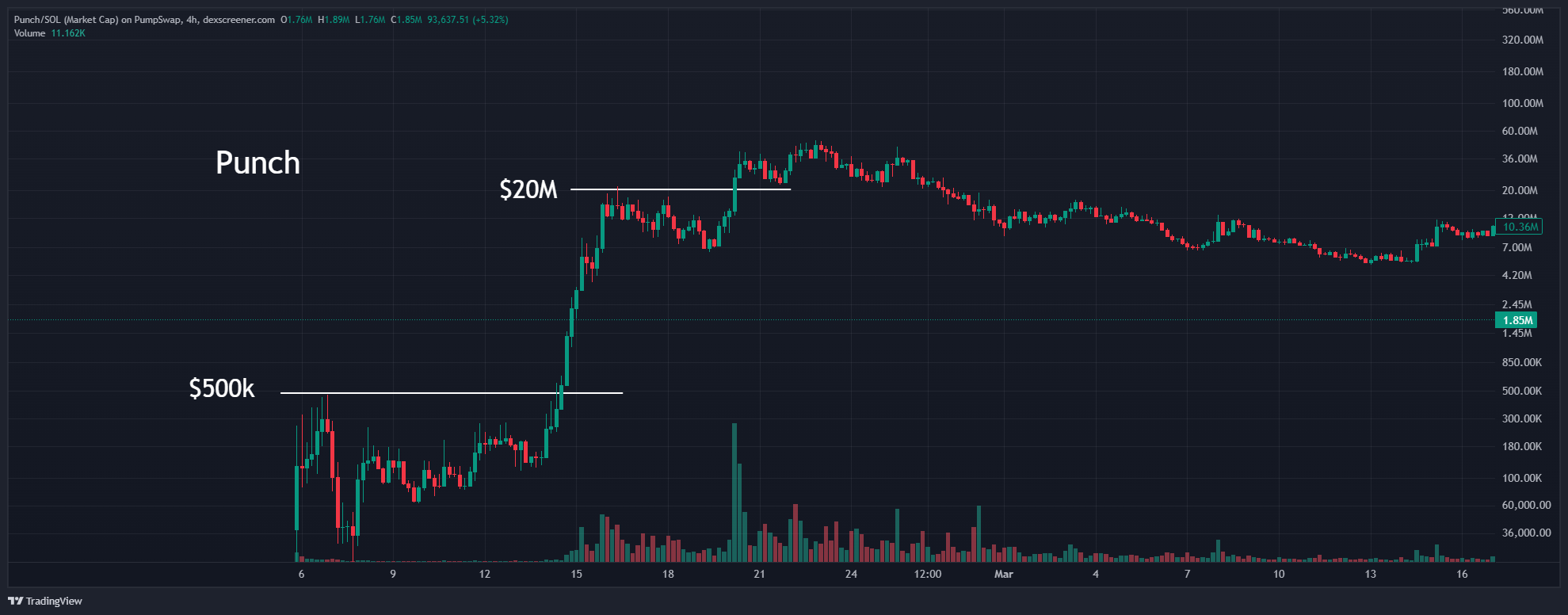
A few days later, Jason called again with another coin rallying, this one called Punch. It went from $20,000 to $50,000,000 in two weeks. A 2,500x move.
It was the same thing, with a clean breakout.
I bought Punch when it broke out again at a $20,000,000 market cap and doubled my money in a day.
This is the easiest market in the world to trade, I thought.
Then Jason said something that felt like a lightbulb moment: "Every trader in this market trades off vibes. Nobody has brought systematic, data-driven trading to memecoins before."
In traditional finance, quantitative strategies have been refined for decades, but in memecoins, people are trading off pure, unadulterated vibes.
If I could get the data and run the tests that nobody had bothered to run, I could find an exploitable edge in this market.
My first attempt.
Before diving into anything complex, I wanted to see if a basic breakout strategy would work. I quickly vibe coded an automated trading bot that bought fresh all-time-high breakouts in early-stage memecoins.
I seeded it with $1,000 and let it run.
By the end of the first week, it was down to $500.
The strategy was abysmal.
So I adapted. Instead of letting the bot trade automatically, I had it send me a text whenever there was a breakout. I'd check the chart, do a quick glance of the community to make sure it wasn't a blatant scam, then buy.
My $500 turned into $300 in a few days.
Just buying breakouts wasn't working.
Why traditional strategies break down.
The problem was obvious.
If I'm buying a memecoin that launched a few days ago with a market cap of $500,000, this thing could correct 50% before I even knew the breakout had failed. Managing risk was nearly impossible.
And it's not like I'm trading breakouts in a stock market of a few thousand securities. In the last 18 months, 18,000,000 tokens have been created on pump.fun alone. Liquidity is spread paper-thin across an ocean of coins.
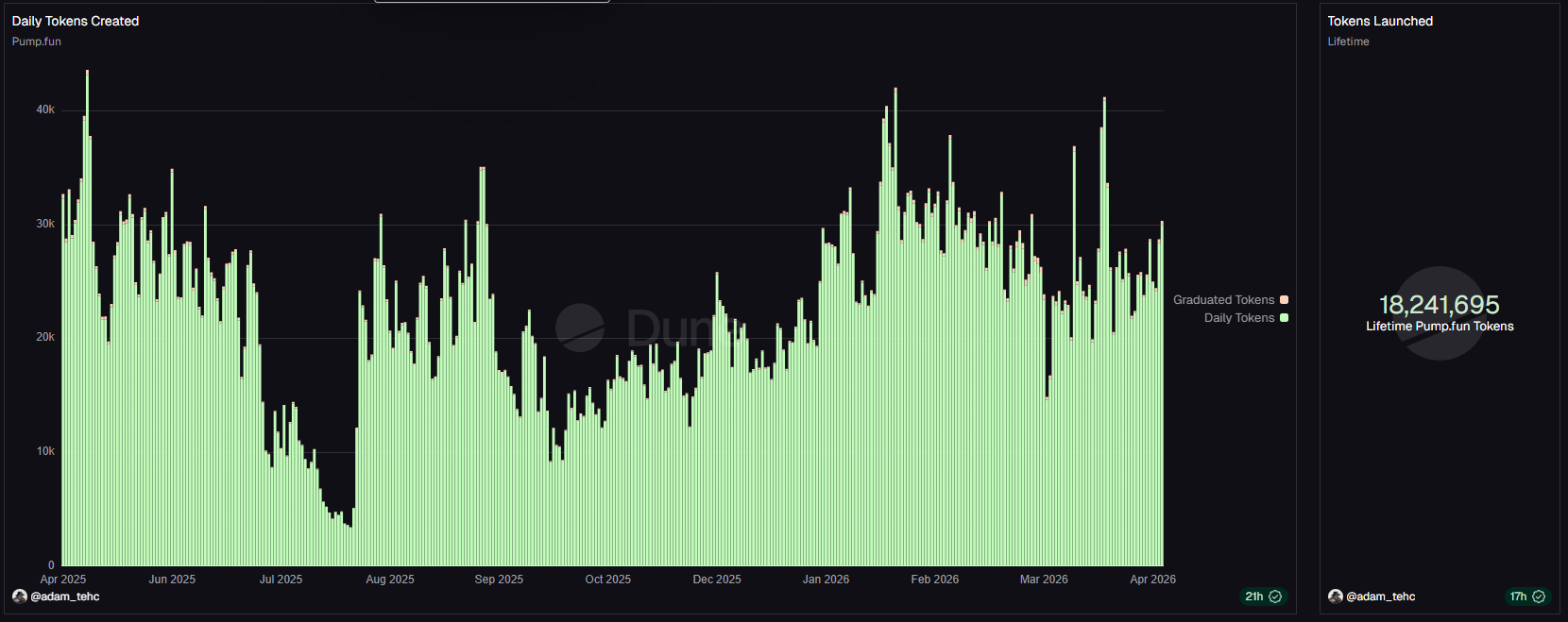
Before any breakout can build momentum, attention and money have already rotated to the next coin that launched two seconds ago.
Classic chart patterns, support, resistance, breakouts - they need sustained attention to work. In a market with infinite fragmentation, that attention never arrives.
If technicals don't work, it was time to go deeper.
Going deeper with 1.5 billion transactions.
I got on the phone with every major Solana data provider.
Here's the thing about memecoins that makes them fascinating from a data perspective: every single trade is public. What wallet bought or sold, how many they traded, at what price. This is an order flow trader's wet dream; they would kill for this data in traditional finance.
I figured that if I had all of these individual transactions across the entire Solana universe, there had to be some method to the madness particularly because no one has really tested it using systematic trading principles.
Whether it's following the wallets with the best track records, analysing aggregate buying and selling pressure, how much profit they're sitting on. I could slice and dice this market in so many ways.
$5,000 and months of grinding later, I had the dataset I needed: over 1.5 billion individual transactions across 25,000 memecoins.
Critically, the dataset was adjusted for survivorship and my own internal filters to ensure it was totally clean. I wasn't just testing on the coins that mooned, like Nietzschean Penguin or Punch. I included the thousands of coins archived on charting platforms that went nowhere or went to zero. Without that, the results would've been inflated and meaningless.
This was, as far as I know, the single cleanest dataset ever assembled to backtest trading strategies in a market where nobody had backtested like this before.
I'll surely find a profitable strategy, I thought to myself.
I didn't.
My first hypothesis: memecoins are purely extractive assets. People buy in, ride the price up, and sell to the next person. So the price should trade closely with how much profit wallets are realising. When they've extracted enough value, they move on to the next scam.
I built the strategy. It lost money.
Then I tested whether I could buy uptrends and time entries using that proprietary profitability metric. Still lost money.
Then I spent a month building an entire database of over 50,000,000 wallets, identified the most profitable ones, and tried to follow their trades. That didn't work for reasons so complex they deserve their own post.
Then I tested coordinated buying activity, when clusters of wallets start buying at the same time. Didn't make money reliably.
Each test took hours to run, combing through hundreds of millions of individual transactions; this wasn't a quick scan of price charts. I was testing at the level of every single trade that had ever been made across 25,000 coins across multiple liquidity pools.
Over a hundred strategies later, the output was ruthless.
In systematic trading, if a strategy shows promise in initial testing, you validate it on fresh data it's never seen before. Not a single of my strategies even made it that far.
The uncomfortable truth.
Here's the number that tells you everything: just 0.3% of wallets have ever realised $10,000 or more in profit from memecoins.
And that 0.3% aren't winning because they're better traders in any traditional sense. They're winning because they have a structural information advantage that no dataset can replicate.
When a new memecoin launches, bots buy the very first tick of the token via hundreds of wallets carefully designed to make the transactions look organic (like real people getting excited about a new coin). By the time a human spots the coin on Twitter, gets excited, and clicks buy, they're purchasing from someone whose effective cost basis was zero.
This problem has only got severely worse; again for reasons far too complex to break down here today.
On top of that, the creator and large holders of any given memecoin knows something you can never know: their own intent. Do they plan to hold and build a community? Dump at a certain market cap?
No data in the world can tell you which one it is. You're making a bet where the other side of the table has perfect information and you have none.
That's the adverse selection problem. When you choose to buy a memecoin, you're being chosen too. You're selected as the person who will absorb someone else's exit.
So what's the takeaway?
The memecoin market operates on a simple, brutal mechanic: money flows from the many to the few, and the game is designed so you can't tell which group you're in until it's too late.
The biggest edge in memecoins is knowing you don't have one.
And the best trade I made in this entire experiment today was the decision to stop trading.
Cheers,
Louis Sykes
Senior Crypto Analyst, All Star Charts